
I carry four Canon tilt-shift lenses on an architectural photography job, at focal lengths of 17mm, 24mm, 50mm, and 90mm. Of these, the Canon TS-E 24mm f/3.5L II is the one I reach for most, probably 75% of the time, maybe more. It's a reliable generalist lens. Since I purchased one, there hasn't been a commissioned project where I haven't used it.
The other three lenses in my kit each answer a specific need, when a composition calls for something wider or tighter. For everything else, I tend to favor the field of view of a 24mm, and this is the lens I trust to deliver it. This focal length is just the right amount of wide to suit most architectural applications. It's sharp and the optics hold up across the full range of tilt and shift. The knobs need regular attention, but otherwise the lens stands up to frequent heavy use.

Canon TS-E 24mm f/3.5L II
Field of View
A 24mm lens is wide enough for tall buildings and small interiors alike, and moderate enough to avoid the stretched proportions ultra-wide lenses produce toward the edges of the frame. The result is closer to how a space feels in person. It shows most in interiors, where an ultra-wide lens can make a small room look uncannily distorted.
The earliest perspective control lenses were 35mm, very close to the normal 43mm lens on a full-frame camera. The 24mm widens that view enough to include an entire building, or a substantial section of a facade, without needing much distance from the subject. That's a real advantage in dense urban areas, where there's rarely room to back up.
Our field of vision is surprisingly narrow. We take in a space a piece at a time and assemble it together into a kind of mental collage. A 24mm lens approximates the assembled sense of a place, the way it feels once we've looked around and assessed. On a full-frame camera it covers 84 degrees diagonally, wider than we see at any single moment, but closer to how we perceive the totality.
Across a body of work, collage becomes montage. Using one focal length for most of a project can help to visually hold the set together. When most frames share the same perspective, a sequence can move through a building's interiors and out to its surroundings without abrupt shifts in scale.
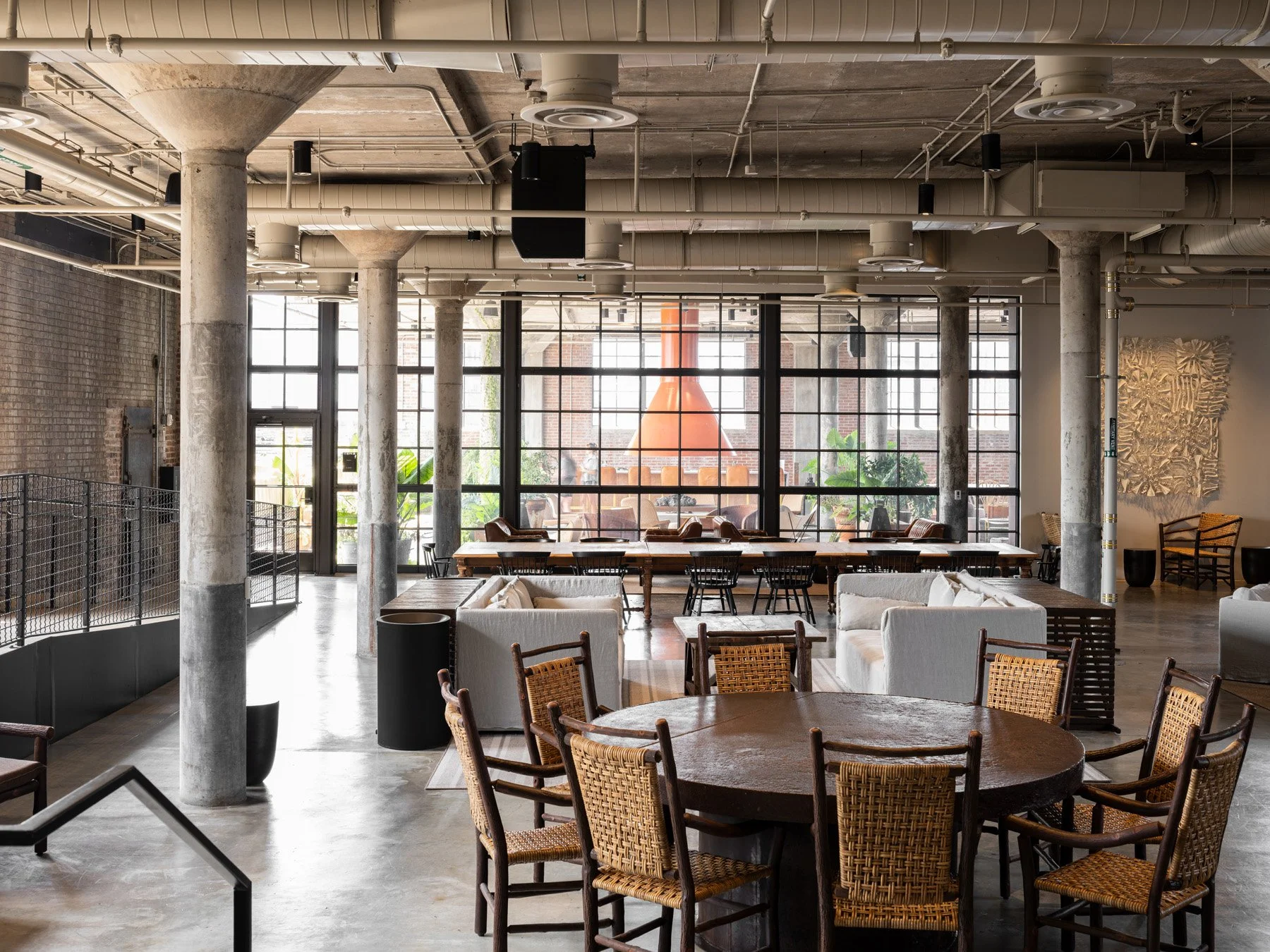
Neuhoff District, Smith Gee Architects, Nashville TN. Photographed with Fujifilm GFX100S and Canon TS-E 24mm f/3.5L II lens.
Optics
The lens is very sharp across the frame and practically distortion free. Its design uses ultra-low dispersion glass and an aspherical element, which keep chromatic aberration minimal and barrel distortion slight. Straight lines stay straight to the edges of the frame, which matters on any building organized around a grid.
Lenses tend to degrade in high-contrast areas near the edge of the frame. A classic example is a glass and steel modernist building, with some rise applied. Lateral chromatic aberration appears as colored fringing, and it worsens toward the edge of the image circle. On this lens, fringing stays minimal even with substantial shift. Canon's proprietary Subwavelength Structure Coating keeps flare and ghosting well controlled, even with direct light aimed at the lens.
Mirrorless cameras have made this lens more valuable. With an adapter, it mounts on nearly any system, so owning it no longer means being married to those dreadful Canon bodies. I've used it on a Nikon Z7 and a Fujifilm GFX100S.
To allow its movements without vignetting on full frame, the lens projects a 67.2mm image circle, well beyond the 43.2mm a full-frame sensor needs. Image quality is acceptable at moderate shift even at f/5.6, and very good at f/8 and f/11, even at maximum shift.
That surplus is also why it works on medium format. I use it on a Fujifilm GFX100S with a Fringer adapter, where the 44 x 33mm sensor takes up most of the circle. Vertical shift vignettes at its maximum, and those frames do need minor correction. But maximum shift isn't the norm, and the lens is still usable across the full range. On the big sensor it has roughly the field of view of a 19mm on full frame, and I usually crop a little.
Its resolving power holds up on the 102-megapixel sensor, and optically it's better than most other retrofocus lenses. It falls short of a high-end large format lens like the Rodenstock 35mm f/4.5 Apo-Sironar Digital, but that's like comparing the torque output of an SUV to that of a semi truck.

100 Above the Park, Studio Gang, St. Louis MO. Photographed with Nikon Z7 and Canon TS-E 24mm f/3.5L II lens.
Construction
The lens is solidly built, with aluminum die-cast tilt, shift, and rotating units, and it feels good to use. It stands up to frequent heavy use, and weather sealing keeps dust and moisture out of its moving parts, including the tilt and shift mechanisms.
The knobs are its weakest link. They are small and fiddly, hurt like hell to use in the cold, and they need upkeep. I've had to repair the knobs on all of my tilt-shift lenses, so I keep spare parts in the office and a J00 screwdriver in my bag. The screws need regular adjustments, tight but not too tight. If they work themselves loose, and they will, the knobs and their washers can fall off. Both movements have locks, which hold a setting once it's dialed in.
The focusing ring is smooth and precise, but a small bump or a movement can easily throw the image out of focus. The same goes for tilt, where a small change moves the plane of focus quite a bit. I check and recheck focus in magnified live view, with focus peaking on.
A key feature of this lens is the independent rotation of its tilt and shift axes, a capability unmatched by comparable lenses. Shift is used to correct verticals while tilt swings the plane of focus vertically or horizontally. I use tilt most when a strong, receding plane needs to be sharp end to end, and more so the longer the lens. On the 24mm, I'm usually making small lateral adjustments to maximize focus across uneven planes.
The lens takes standard 82mm screw-in filters. I use PolarPro circular polarizers and combined neutral density polarizers, and they work great.

Lateral tilt movement on Canon TS-E 24mm f/3.5L II lens
Comparisons
Several alternatives exist, and some are excellent at what they do. As a primary lens for architectural photography, none balances focal length, value, and ease of use as well as the Canon 24mm.
The Canon TS-E 17mm f/4L is an amazing lens for what it is, and it's in my kit. It's also far too wide for most situations, and it only comes out when there's no room left to back up. Some photographers use this lens a little more regularly than they probably should. When things go wrong with it, they go uncanny valley wrong.
Optically, its corners soften under shift in a way the 24mm's don't, it shows some barrel distortion at the extremes, and it's prone to field curvature. Its bulbous front element also rules out standard screw-in filters.
The Nikon PC-E Nikkor 24mm f/3.5D ED shares the focal length but falls short in use. It vignettes noticeably at maximum shift, and its barrel distortion is pronounced, curving upward as the lens shifts. Both problems show up most on tall buildings at close range, which is exactly when shift matters most. Its tilt and shift axes also can't rotate independently without a factory modification.
Canon's original TS-E 24mm f/3.5L, introduced in 1991, sells for much less used. I haven't used it, and I doubt it holds up. It predates Canon's Subwavelength Structure Coating, and its tilt and shift directions are fixed relative to each other, since independent rotation arrived with the Mark II. Its 58.6mm image circle is also smaller, which leaves only a few millimeters of shift on medium format. And older wide-angle designs tend to be barrel distortion nightmares. Even older large format wide angles from Schneider disappoint by current standards.
The Laowa 15mm f/4.5 Zero-D Shift costs less, and it's the widest of the group. It's shift-only, so there's no tilt to control the plane of focus. Despite the "Zero-D" name, I've found it distorts about as much as the Nikon, and its edge sharpness and chromatic aberration fall well short of the Canon's. At 15mm, it also has the 17mm's width problem, only more so.
For GFX shooters, Fujifilm's GF30mm F5.6 T/S is a newer, native alternative. On that sensor it has the field of view of a 24mm on full frame, and its larger image circle allows ±15mm of shift. It's also heavier, takes 105mm filters, and costs nearly twice as much as the Canon. I haven't used it yet, so I can't attest to its performance.
Of course, the nuclear alternative is a technical or view camera. I have an Arca-Swiss F-Metric 5x7, and it's a pain to use. Everything is manual. To make a single exposure, I level the camera, open the lens, frame and focus in live view, close the lens, set the aperture and shutter on the lens, cock the shutter, press a wake-up cable, and fire within four seconds. Forget any step and the frame is ruined. Also, every shot with movements requires a calibration frame, opened up two to three stops, to correct vignetting and color drift, and color consistency is a mess. The Canon on a mirrorless body bypasses all of that.
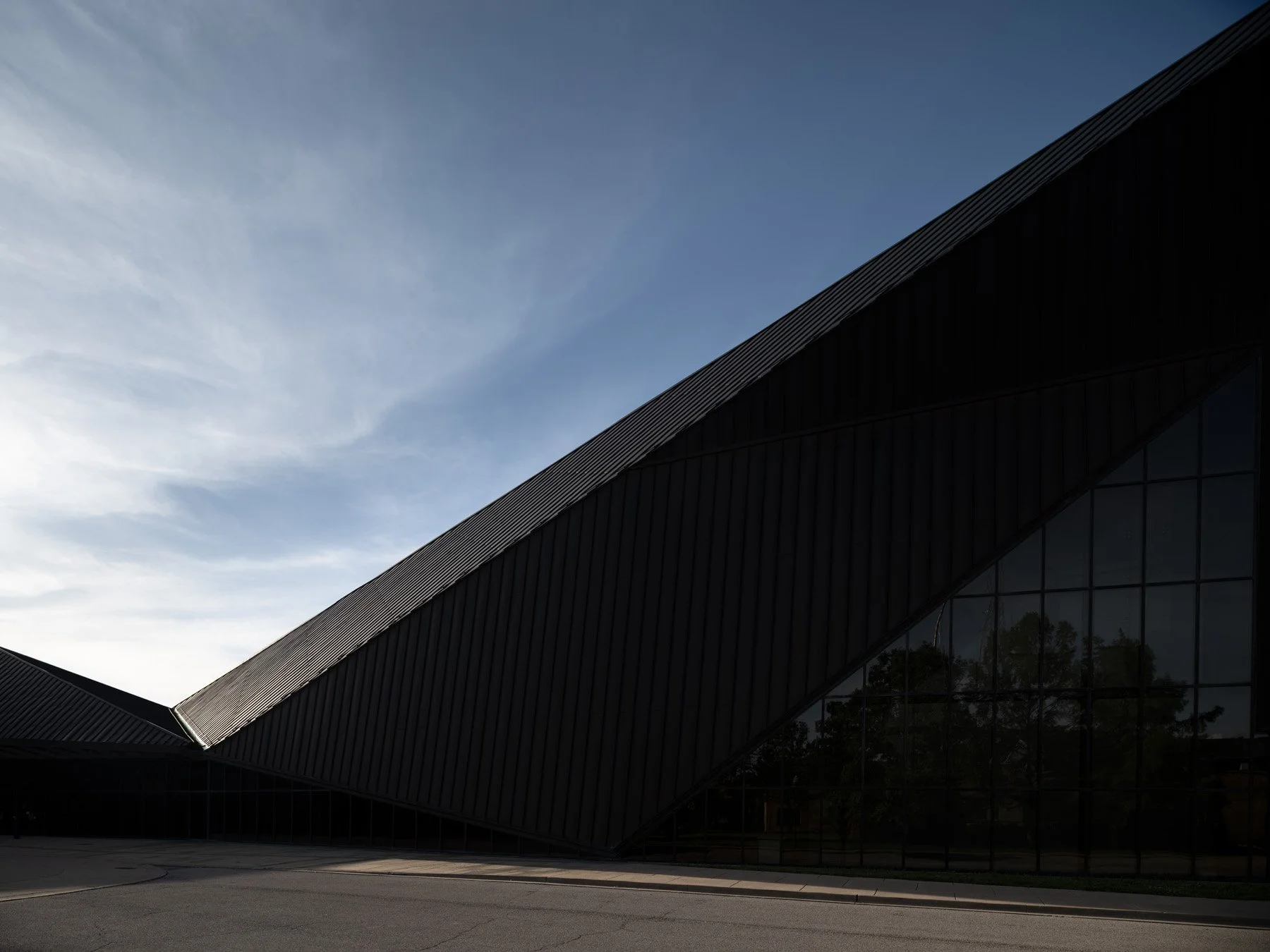
Doudna Fine Arts Center, Antoine Predock, Charleston IL. Photographed with Fujifilm GFX100S and Canon TS-E 24mm f/3.5L II lens.
Should You Buy One?
The Canon TS-E 24mm f/3.5L II is the single best lens for architectural photography, because it offers the best combination of focal length, value, and ease of use. It's very sharp, very well made, practically distortion free, and on my camera for most of the frames I make.
Whether or not to buy one depends on what you're trying to do. It's a manual focus tilt-shift lens, and it takes patience. Expect repeated focus checks and knobs that need looking after. For a professional, it removes most of the nuisance of a view camera while preserving the functionality. For a hobbyist, it asks for a constellation of good photographic habits.
If you do buy one, buy it used, from a seller with a return policy. That's good advice for most lenses, since they hold their value well on the secondary market. Any copy can be a lemon, and I've heard horror stories from colleagues who have received faulty copies of a wide variety of lenses. Caveat emptor.