
One Moment: People in Architectural Photography
It's the spring of 1850 in Luxor. A robed man poses in front of one of the massive columns of the colonnade of Amenhotep III. He's standing contrapposto, holding still, facing the camera. The photographer is Maxime Du Camp, a French journalist with no prior photographic experience who studied with Gustave Le Gray before embarking for Egypt. The robed man is standing at the foot of the column for scale. Du Camp wanted the camera to be what he called an "instrument of precision," and a man of ordinary height was the ruler he held up against the stone.
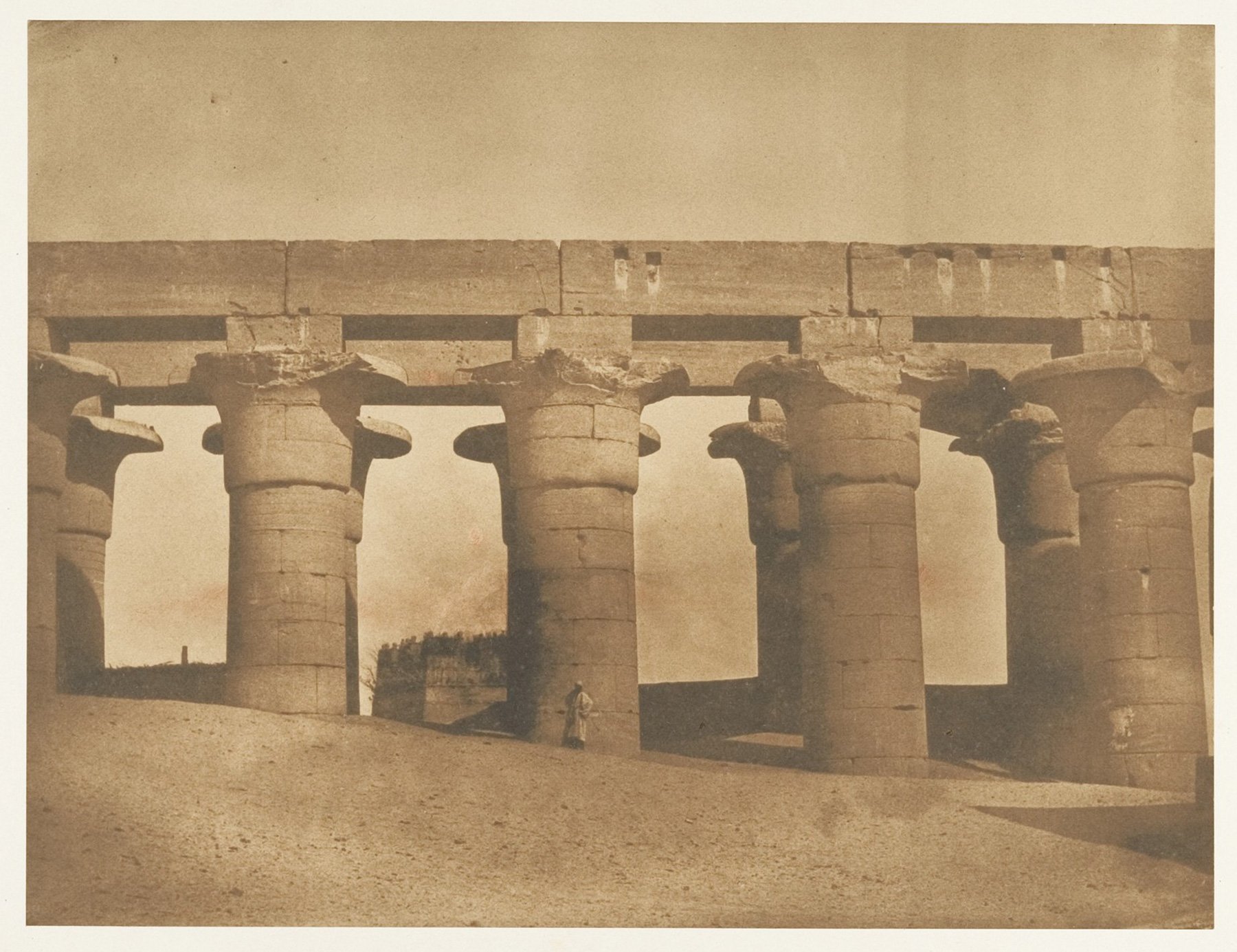
Maxime Du Camp, Grande Colonnade du Palais d'Aménophis III, à Luxor, Thèbes
Why do we include people in architectural images? Over a century later, the great architectural photographer Norman McGrath wrote that "figures are necessary for scale." But Du Camp's habit of sending his traveling companions to pose on and around the ruins was never entirely about scale. As art historian Julia Ballerini has argued, this was a shaky performance of precision in a few ways. Du Camp's measure wasn't uniform. He used multiple models, and the figure's distance from the camera was inconsistent. Where Du Camp placed the figure seems to serve the graphic quality of the picture more than any notion of measurement. In the Luxor photograph, what did you register first, the columns or the man? The figure often becomes the picture's focal point, and when he shrinks to a speck in some of the other frames of Égypte, Nubie, Palestine et Syrie, we find ourselves searching for him.
Scale is legible through our familiarity. Contemporary exterior pictures already have cars, telephone poles, lampposts, and stop signs, all of the objects of daily life. Interiors have their own scale markers in doors, books, and tables. As long as something familiar is in the frame, the viewer can measure the building against it. A person is just one more familiar object, and whatever Protagoras said, man isn't the measure of all things here. There's nothing special about a figure as a scale rule.
What a figure does add is a narrative fragment, one incomplete piece of many possible stories. I have this mantra of "one moment." If there are going to be people in the frame, there should be one identifiable action that can be expressed in narrative terms. The viewer shouldn't be reading four little mini stories. The picture at Luxor passes my one moment test. The man's pose and position relative to the camera tell me that someone told him to stand there for scale.
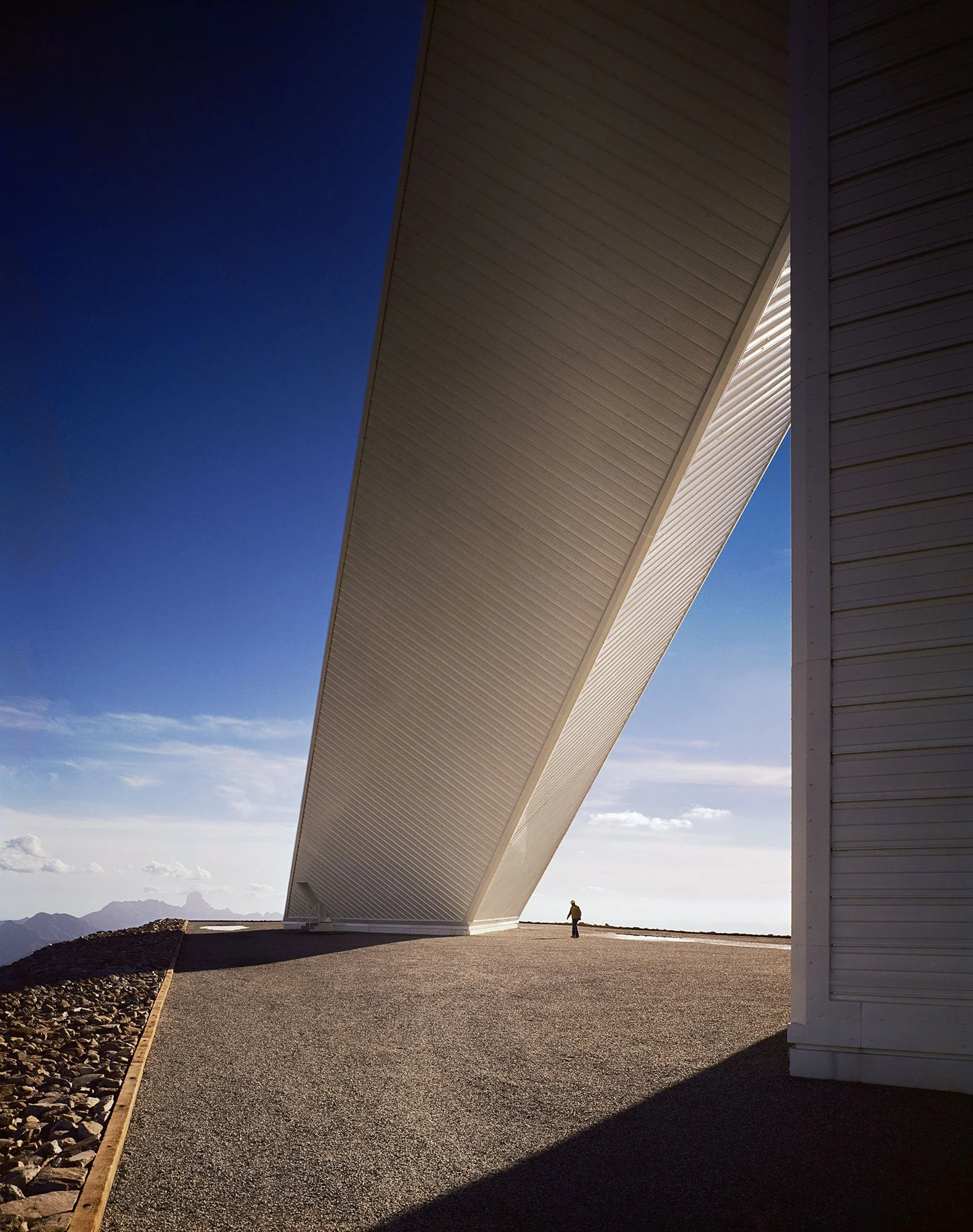
Figure used for scale in the absence of any other referents. Ezra Stoller, Solar Telescope at Kitt Peak National Observatory, SOM, Pima County AZ
Figures can do many things in a picture, but most of them fall into three broad categories, and narrative is one. They also carry visual weight in shaping a composition, directing attention and guiding the gaze. Figures serve instrumental purposes outside the picture. They prove to a client that the new project is finished and functioning, and help sell the promise that it will be well used. Whatever it's doing, the figure should partake in the photograph's logic. Simply satisfying the requirement that a photograph contain people isn't enough.
Before any of the figure's functions come into play, we need a solid stage. The photograph without people is the set they'll occupy. Its lighting and composition should work with and without them, the same way a color image should hold up if the color is removed. The structure of the image is autonomous and self-supporting. It doesn't hang around the figure the way a portrait does.
When an empty frame doesn't work, the figures can take over. If the structure hangs on the figure, it becomes a people image rather than an architectural one. It will also be a weaker frame, even with people in it. People don't rescue weak images. This is tough to reconcile in the middle of a shoot, because clients regularly require unphotogenic spaces to be covered. And a weak stage invites filling it with people.
It's good practice to start with a clean frame and add everything else on top of it. It also serves as a backup, which is old advice. Before compositing was possible, McGrath said "always shoot a couple of alternatives without people in case you change your mind." Compositing affords fine control over small details. Each part of the frame can get its own takes if necessary. That might mean ten exposures of one person on the left doing one action, or small variations of it, then another ten of a small group on the right, with the best takes cut together on the registration frame, the blank stage. I think of it the way records are made, where a solo gets overdubbed onto a pre-recorded rhythm track.
A moment can be expressed in a single sentence. "The girl is late to class and is running for it." "The doctor is giving the patient good news." "Two colleagues are reviewing documents."
The action can belong to one person or a group, and it incorporates the space into a larger story of usage. It comes from people interacting with each other or with aspects of the space. That interaction is what gives the people in the frame meaning.
One of my aerial views of the Mansueto Library at the University of Chicago shows a tour group gathered around Henry Moore's Nuclear Energy. The sculpture marks the site of the first controlled nuclear chain reaction. They're engaging with the history of the place, which is a layer of meaning the built environment can't supply on its own. Or another image of a park in Centralia, with two people entering from opposite sides of the frame, walking toward each other, one of them waving. Nothing says they're meeting for lunch, but that's one possible read the image could support. Neither moment is resolved or explicit. Each gives the viewer something to grasp, a small drama inside an image that's otherwise busy describing the surroundings.
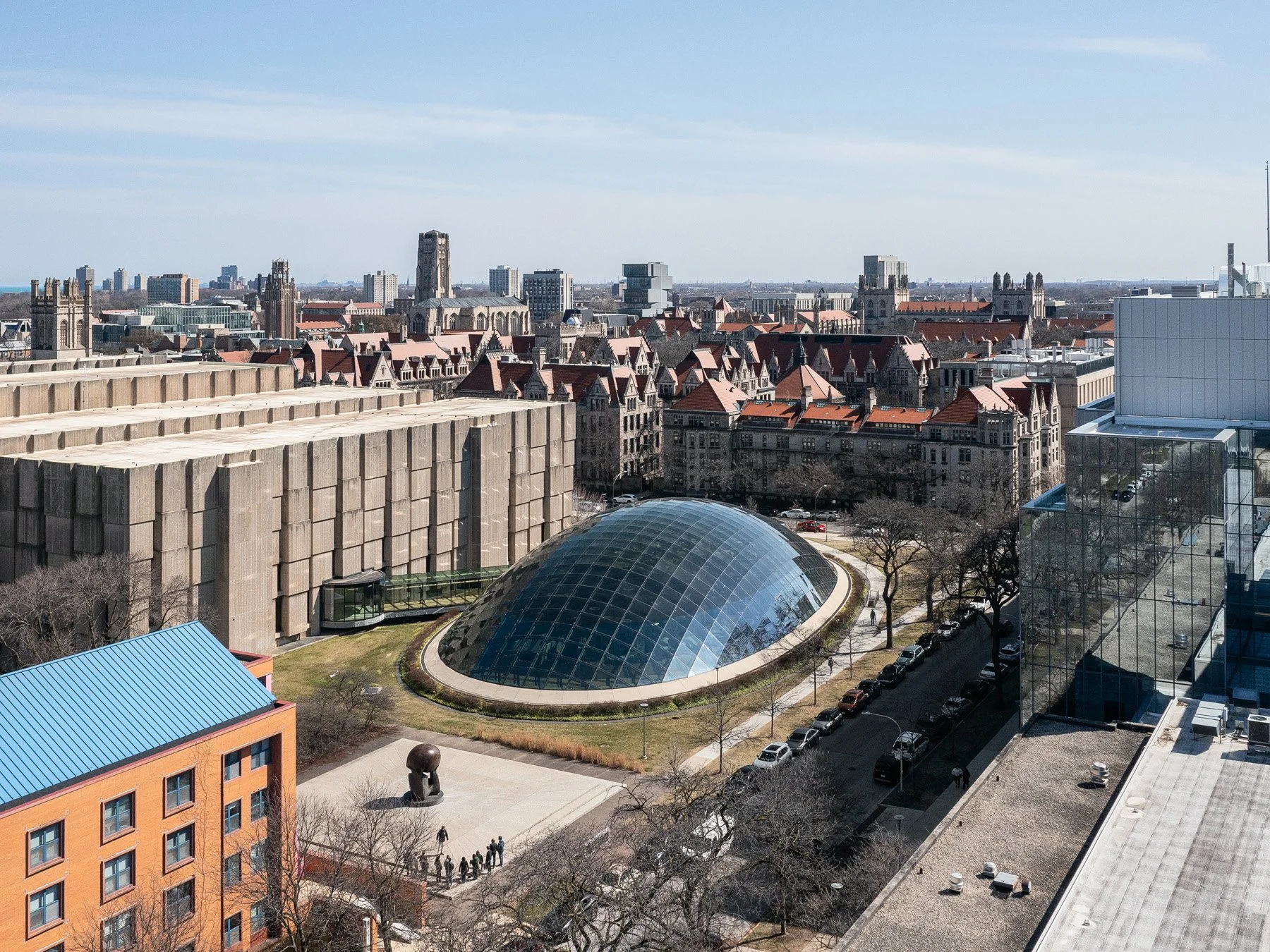
Mansueto Library, Helmut Jahn, Chicago IL.
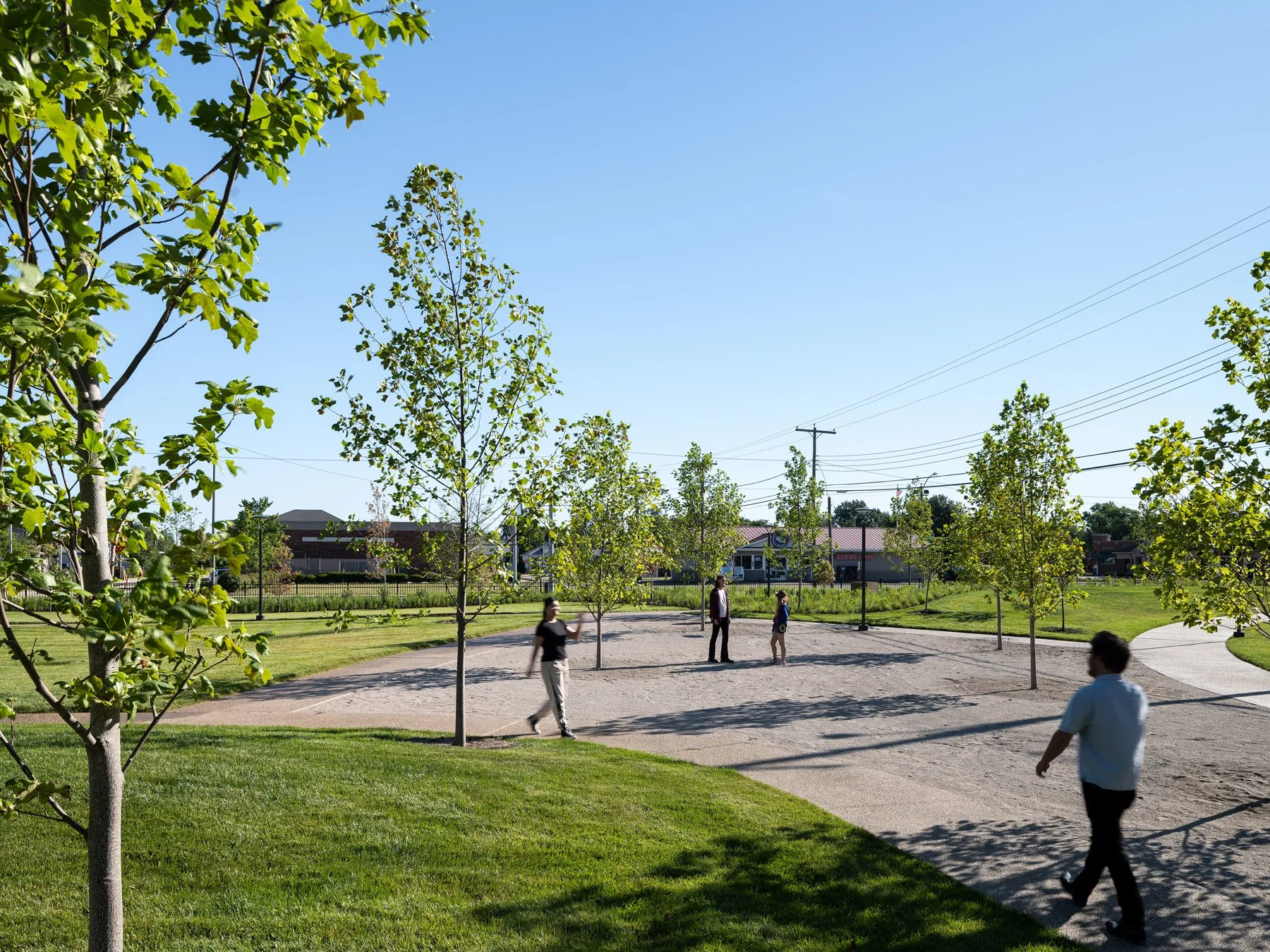
Carillon Park, Arbolope Studio, Centralia IL.
Each frame is a modular narrative block. How each one lands depends on the context it's placed in, and commissioned architectural photographs get used across many contexts by different parties. Allan Sekula argued that the meaning of any photograph is "necessarily context determined": on its own, a photograph offers only the possibility of meaning, and each new setting generates its own.
None of that works if the viewer doesn't believe it. Non-models have a looseness that is very difficult to replicate. Models, who can be anyone performing for the sake of the image, almost always feel stiffer, with over-performed gestures. It's evident in their body language. The model version reads as a contrivance, and most of the time nobody objects. A non-model is in the space for their own reasons; a model is there to be photographed. I suspect viewers can tell the difference.
McGrath wrote that "the problem with including people in photographs is having them appear natural," and his fix was a dry run: going through the motions of shooting without film until people got tired of posing and relaxed. With a digital setup, the equivalent is to blow a bunch of frames at the start just to get people to loosen up, expecting to delete them. Sometimes the early frames are good, but it's uncommon.
Once people have loosened up, the rest is directing. It's a good rule of thumb to give a walking figure a path and a pace, a stationary one a motivated task, and both a direction to look. The question is always what people would actually do in that spot.
Balance is the most basic compositional use of a figure. People are the first thing a viewer notices, faces most of all, so a figure carries a lot of visual weight relative to its size. Put a person in a frame and the balance shifts. Say you add a figure in the foreground of an otherwise balanced composition. You have to add something else as a counterweight to that new information. Accent works the same way at a smaller scale. Imagine a tiny red figure in a mostly green and blue frame. It carries weight far disproportionate to its size, because warm colors advance and cool colors recede.
Figures can also cover undesirable elements in the frame. Removing things in software always feels a little like cheating, and it doesn't always go well. At the Ferguson International Center at Indiana University in Bloomington, the right side of the frame was an empty road, and the left side had some detritus that needed de-emphasis. I was waiting for a car blur to mask the left when a peloton of cyclists came down the road. When they passed the building, they covered the boring and unpleasant parts of the frame and gave the building a visual counterpoint.

Ferguson Internatonal Center, Thomas Phifer & Partners, Bloomington IN
Movement and gaze lead the viewer through the frame. When a figure is moving toward something or along a path, or simply looking at it, the viewer follows. Leave space for them to move into, and the viewer completes the action. If there is an important feature, have people walk toward it, not stand on top of it.
Repoussoir, a figure or object at the edge of the foreground that frames the scene and draws the viewer inward, is a constant in architectural photography, though it's rarely done with a figure. The Rückenfigur, a figure seen from behind who stands in for the viewer, is almost absent from contemporary architectural photography. The man at Luxor is its opposite. He faces the camera, so he measures the building without leading the viewer into it.
One figure can be both repoussoir and Rückenfigur. In a one-point view of a nursing school's viewing room, a woman stands off to the side of the frame, and we look with her, over her shoulder, at the action in another room. She segments the depth of the frame and sets the direction we look. It's a complex move, and it may not fully work, but these are the things I think are worth attempting if we're going to be including people.
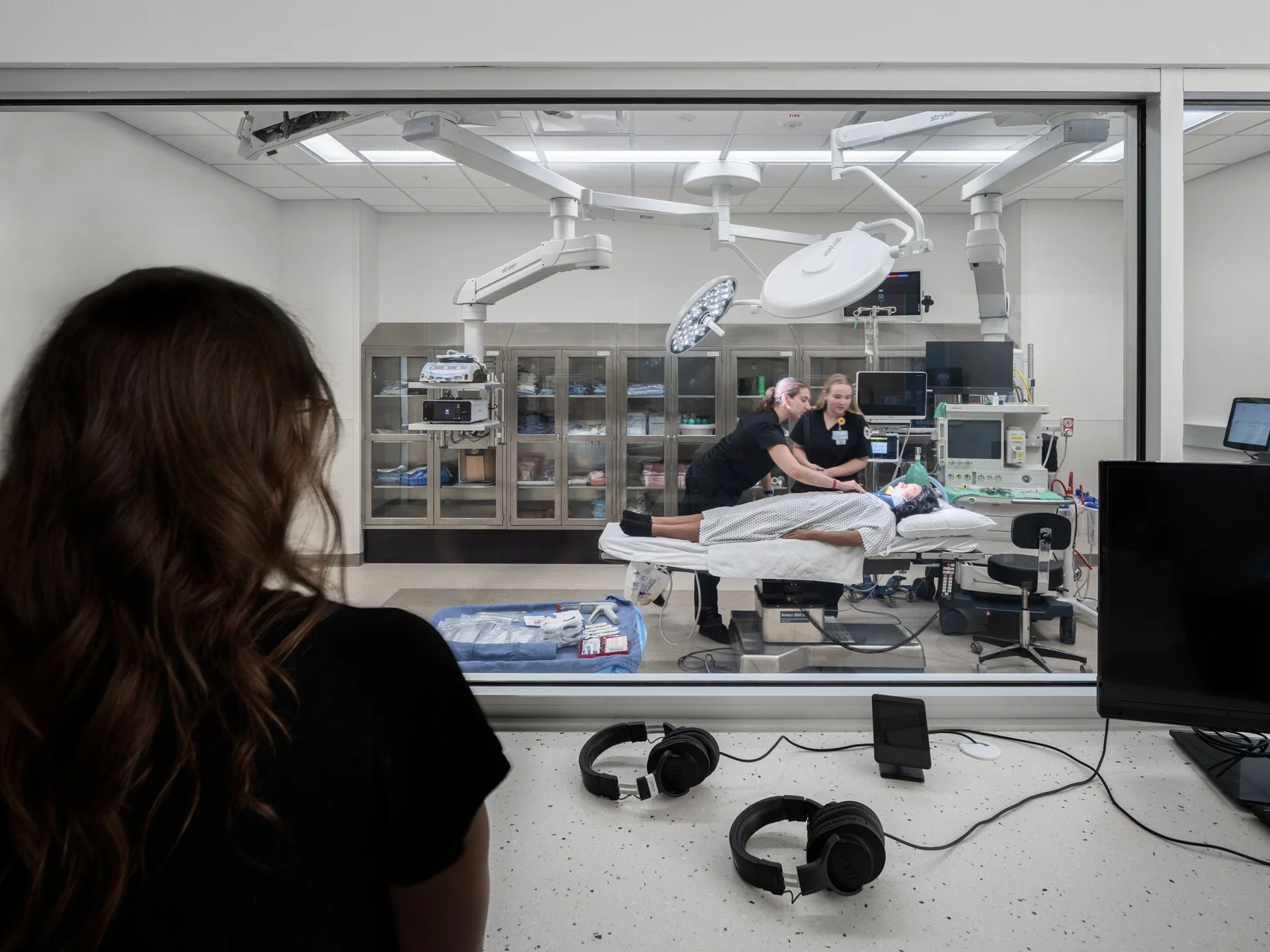
SIUE Health Sciences, Lamar Johnson Collaborative; Christner Architects, Edwardsville IL
Architectural photographs tend to keep people at a polite distance. Full figure, mid-frame, mid-stride, mid-action. Leonardo da Vinci saw the same timidity in painting. He complained about painters who cared only for faces, whose own figures were motionless, and who censured "things that have greater and quicker movement than those done by themselves, saying that they look possessed." That timidity probably comes from the instrumental pressures that also fill frames with people, and from conformity, wanting to fit in with what everyone else is doing. Either way, it's worth pushing back against convention once in a while.
It is too easy to let go and fill an image with people. Crowds usually read as a single entity. The trouble starts with too many little groups, each doing its own thing, cluttered relative to the frame. When it happens, the illusion of the image breaks, and it feels manufactured.
The test is to ask what is happening in a scene, and whether multiple things could plausibly happen at the same time. And are they pulling in the same direction? A frame with a few groups all talking over desks works, because it's the same action repeated, and it reads as one moment. Imagine a campus lobby with a student on a laptop, two people chatting by the stairs, someone wheeling a cart, and a runner passing outside the glass. Each is plausible on its own. Together they pull in four directions, and the frame loses its center.
Architects' renderings tend to be crowded with people, and on a commissioned shoot, the photographs generally follow the rendering's lead. A rendering is selling something that doesn't exist yet. Fabrizio Gallanti sees the figures as a promise that the building will be full of life and energy, populated by an idealized cohort of users.
Most of the people a rendering has to persuade aren't architects. Planning boards, donors, trustees, investors, future tenants, and so on. Julia Dorothea Schlegel, writing in CLOG, cites studies showing that non-architects find photorealistic renderings more valid and reliable, because they're drawn to the life and the atmosphere more than the building. If you put a person in an image, the balance skews toward the figure. People enjoy seeing people in images doing the things that people do. Clients ask for more of the same. A visualization studio reports that its clients spend much of their time tweaking the figures, and that it's more often adding people than removing them.
All of this adds up to the rendering as an illustration of the program, showing every intended use at once. Packing in as much program as possible makes economic sense in a rendering, but it is terrible for photos. A cluttered photograph fakes the rendering's simultaneity in a medium that can only show one moment. Alberti warned against painters who, wanting to seem copious, leave no part of the picture empty. As a better model, he pointed to the playwrights of ancient Greece and Rome, who told their stories efficiently, with as few characters as they could.
The need behind all those figures is legitimate. Firms do need proof that a building is complete and working as designed. Showing people using it is clear testimony. This tends to be a problem that arises out of collaboration rather than intent. It's an artifact of the instrumental function of the image: it needs to sell, it needs to placate, someone is paying a lot and needs boxes checked, someone worked on a rendering and wants it carried forward. Anyone can check whether a picture has people in it. Whether it has one good moment is harder to judge, so clients default to the countable version and ask for more people.
When it's just me working, I'm much more judicious about who gets included, if anyone. When the shoot is more collaborative, with someone holding the iPad in real time, I'm more inclined to match the renderings and include more figures. The photographer is likely the last person to endorse the clutter.
Figures add a narrative fragment, shore up the composition, act as a rubber stamp, and help sell dreams. The narrative function is the one that persists. The story itself gets assembled across the set of photographs of a building, and then again by everyone who uses them. Sekula saw that a sequence of photographs works by "a kind of montage principle," the images together limiting what any one of them could mean. A cluttered frame arrives with several competing meanings, so a sequence has more to compress and does it less well. A frame with one clear moment gives the sequence something clearer to build with.
Every photograph is a fiction, and a composited one even more so. Nearly everything described so far has been construction. Clean registration frames, the best takes cut together, the directed models, the peloton waited for so it would cover a mess. Is it a plausible fiction that we can relate to, or is it trying to melodramatically manipulate our feelings? That line is crossed when the people in the frame stop being believable.
The picture I think of when I think of one moment is one nobody paid me for. I shot it at the Lewis Center for the Arts at Princeton because I happened to be there and it's an excellent project. The goal with images like this is an editorial placement. I don't think this one got one, but I like it nonetheless. It's a very non-idealized image, shot in early winter, so the trees are bare. I framed the building in a very formally strict way: positive and negative volumes, light and shadow, angular intersections. It's exactly the kind of image that works equally well in black and white and in color, and very much a sunny winter day picture, so it already had a lot of things I really like. I was prepared to do the shot with nobody in it.
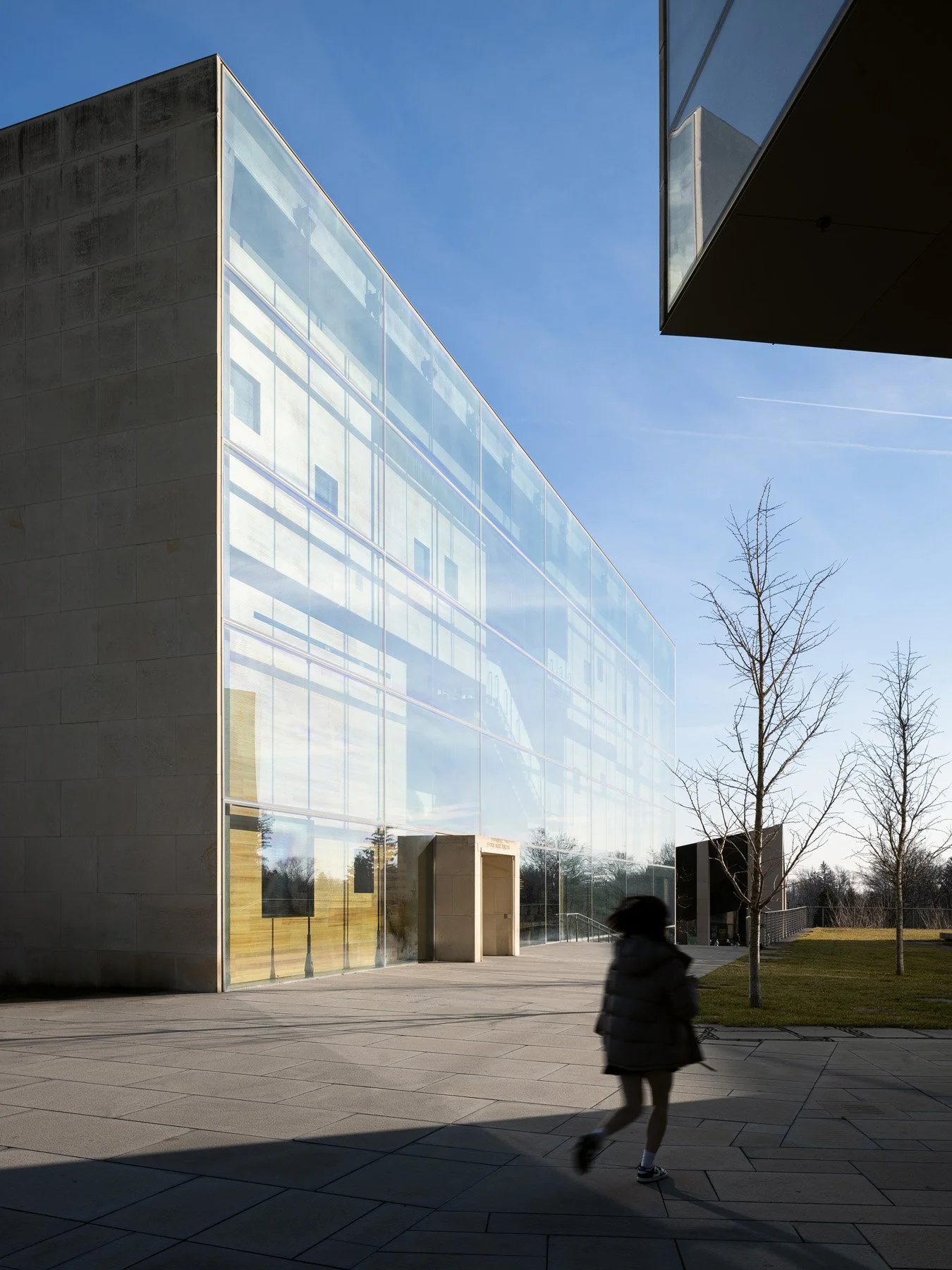
Lewis Center for the Arts, Steven Holl Architects, Princeton NJ.
Then I saw a girl running across the plaza, very clearly late to something. I don't know what. I thought, this is it, quickly set the camera to burst mode, and fired away as she crossed the frame. One of them ended up working perfectly, a human counterbalance to the strict geometry, and it multiplied how pleasing the image was for me. It contains most of the moves I like while resisting being an easy advertisement, and it still shows a fragment of the honest life of a school. I have been this running person before.
When I think of one moment as a concept, I think of this girl and this frame. One doesn't need to keep returning to familiar imaging conventions. We don't have to make the same image over and over again. The figures don't need to explain all aspects of a program, or be everything all at once to everybody. It doesn't even need to be decisive. It just needs to be one moment.
Sources
Julia Ballerini, "The (In)visibility of Hadji-Ishmael: Maxime Du Camp's 1850 Photographs of Egypt," in The Body Imaged: The Human Form and Visual Culture Since the Renaissance, ed. Kathleen Adler and Marcia R. Pointon (Cambridge University Press, 1993). Read via the reprint in The Classic, March 2021. Du Camp quotations are her translations.
Norman McGrath, Photographing Buildings Inside and Out (New York: Whitney Library of Design, 1987).
Allan Sekula, "On the Invention of Photographic Meaning," Artforum (January 1975); reprinted in Photography Against the Grain: Essays and Photo Works 1973–1983 (Halifax: Press of the Nova Scotia College of Art and Design, 1984), pp. 3–21.
Fabrizio Gallanti, in CLOG: Rendering (2012), p. 55. Paraphrased via the ArchDaily review.
Julia Dorothea Schlegel, "Great Weather and Happy People," in CLOG: Rendering (2012), p. 57.
Visualizing Architecture, "Entourage Density: Active vs. Tranquil".
Leon Battista Alberti, On Painting, trans. Cecil Grayson, with an introduction and notes by Martin Kemp (Penguin Classics, 1991).
Leonardo on Painting, ed. Martin Kemp, trans. Martin Kemp and Margaret Walker (Yale University Press, 1989), p. 200.
Maxime Du Camp, Grande Colonnade du Palais d'Aménophis III, à Luxor, Thèbes, May 3, 1850. Salted paper print from paper negative. The Metropolitan Museum of Art, Gilman Collection, Gift of The Howard Gilman Foundation, 2005 (2005.100.376.47). Public domain.