The Case for the Millstadt Mill
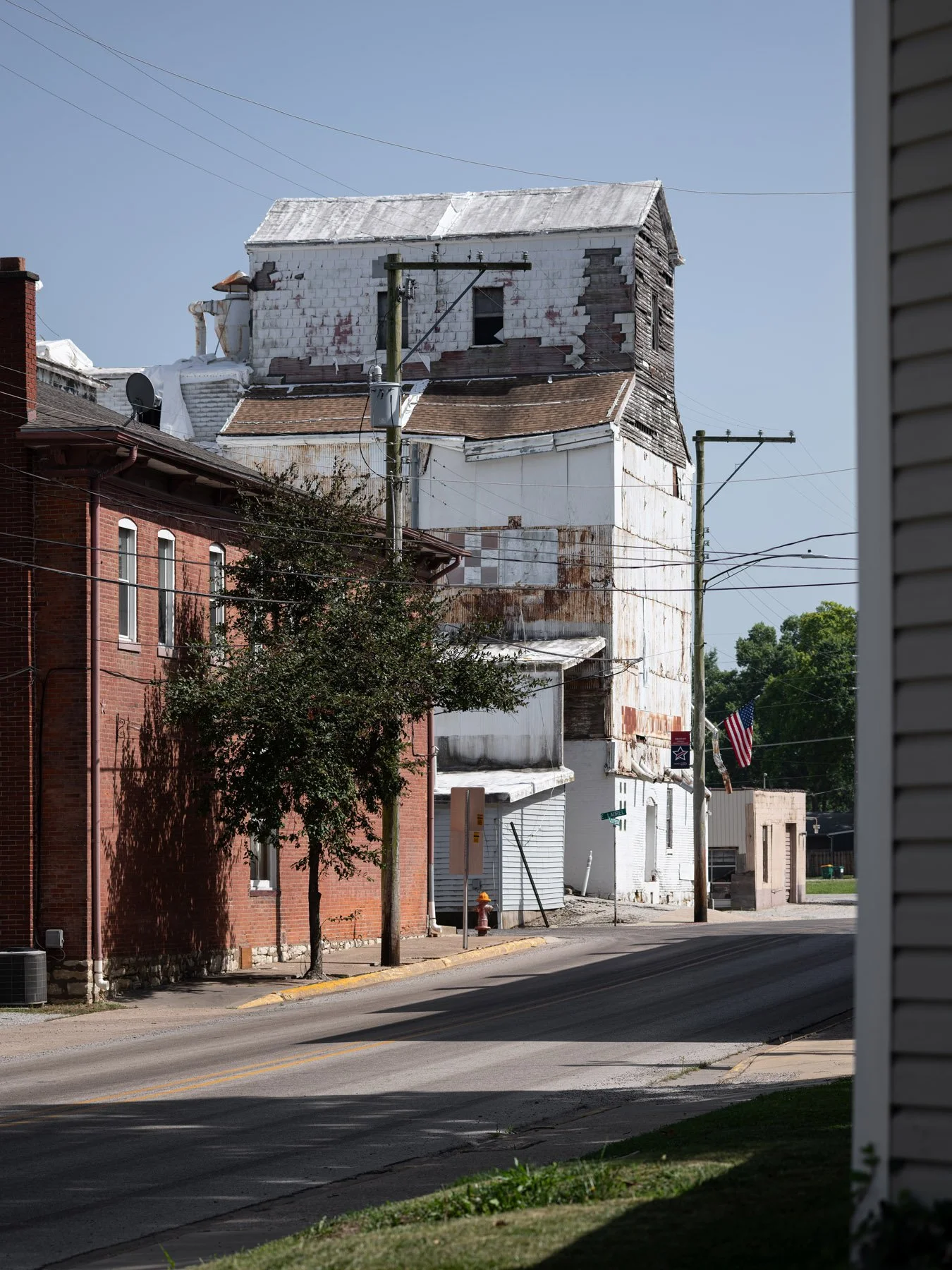
The Millstadt Mill is one of the few surviving mills in the region where both the building and the milling system remain largely intact. Despite that, it has never been listed on the National Register of Historic Places and remains vulnerable to demolition. It stands at the southeast corner of Jefferson and Laurel streets in the small Illinois town of Millstadt, about seven miles southwest of Belleville. The town was settled in 1834 by German immigrants, and milling was its foremost business through the late nineteenth century.
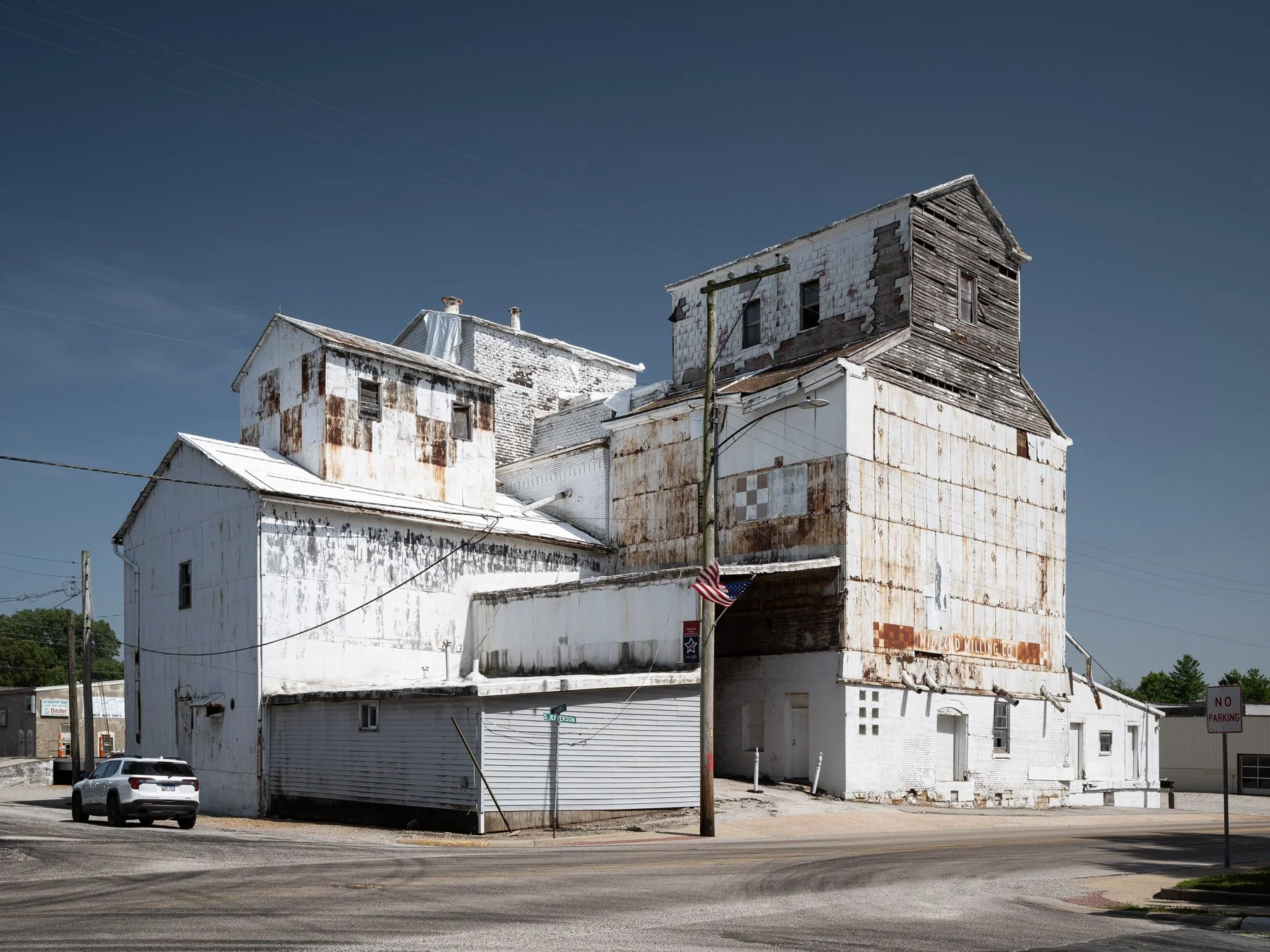
The mill at the southeast corner of Jefferson and Laurel, Millstadt, Illinois.
The mill looks like a single building, but it was built over time in three stages. The mill itself is a brick structure, a timber grain elevator is on the west side, and a later dock expansion on the north side. The upper stories are clad in metal and clapboard over the brick core, whitewashed, with the paint failing in patches so the brick shows through. There is a gaping hole in the brick on the southern elevation. On the facade facing Jefferson street, reads MIDLAND MILLING CO, one of several names the building has carried over the years.
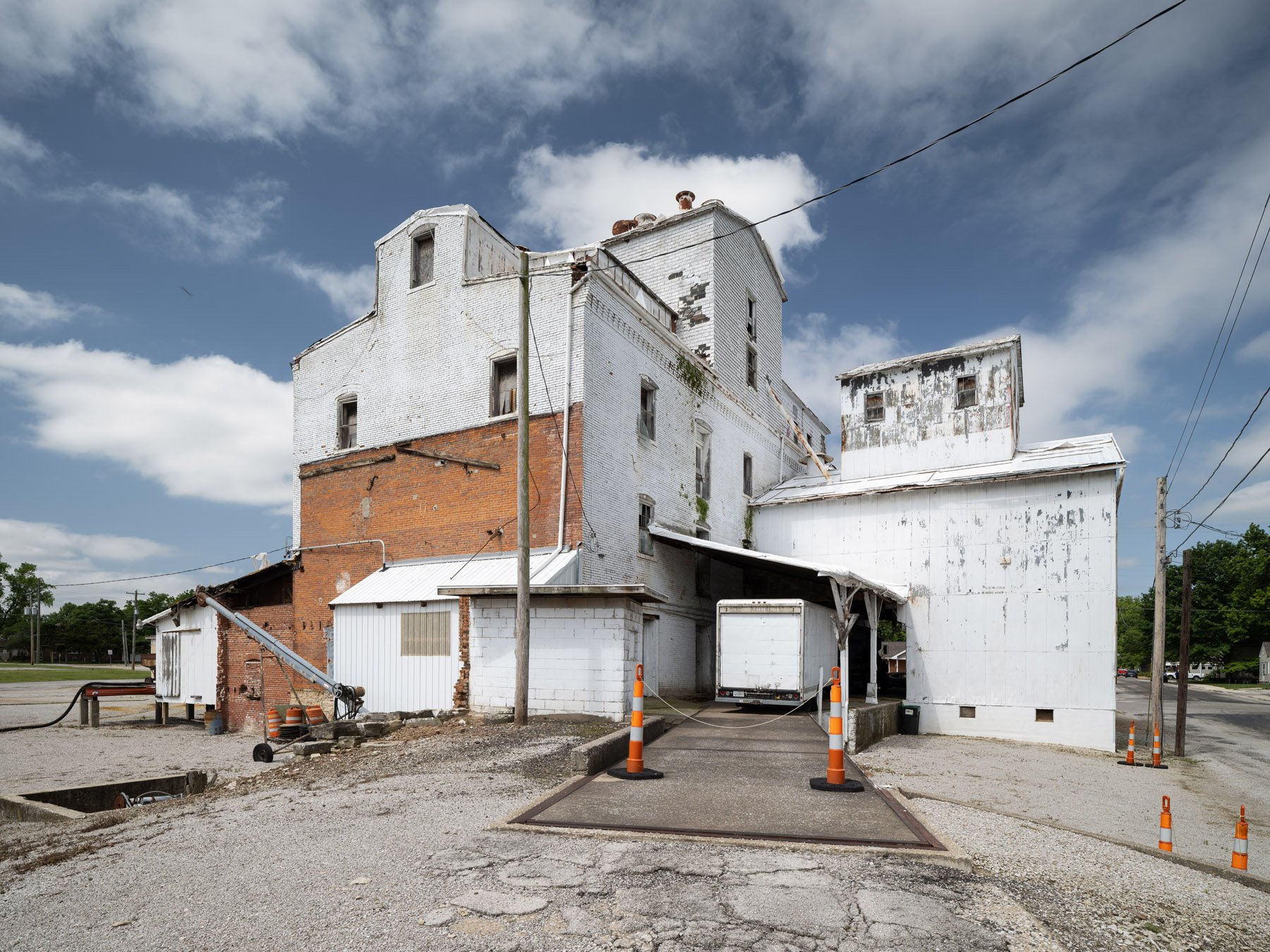
The brick mill block at left; the lighter dock bay at right was added after 1928.
In November 2018 the village declared the site a public nuisance and gave the owners James and Melissa Helfrich until June 2019 to present a repair plan or face possible demolition. That deadline has long passed and the building still stands, damaged and marginally active.
The St. Clair County Historical Society named it a historic site in 1985. In 2019 Landmarks Illinois listed it among the state's Most Endangered Historic Places. There is no National Register of Historic Places nomination for the building. No one has written one yet. The current owners date the mill to 1857 and describe it as the oldest operable timber-frame mill in Illinois. It could very well be. The record, as far as I could find, does not confirm any construction date, but there is a fairly clear chronology of who occupied this parcel.
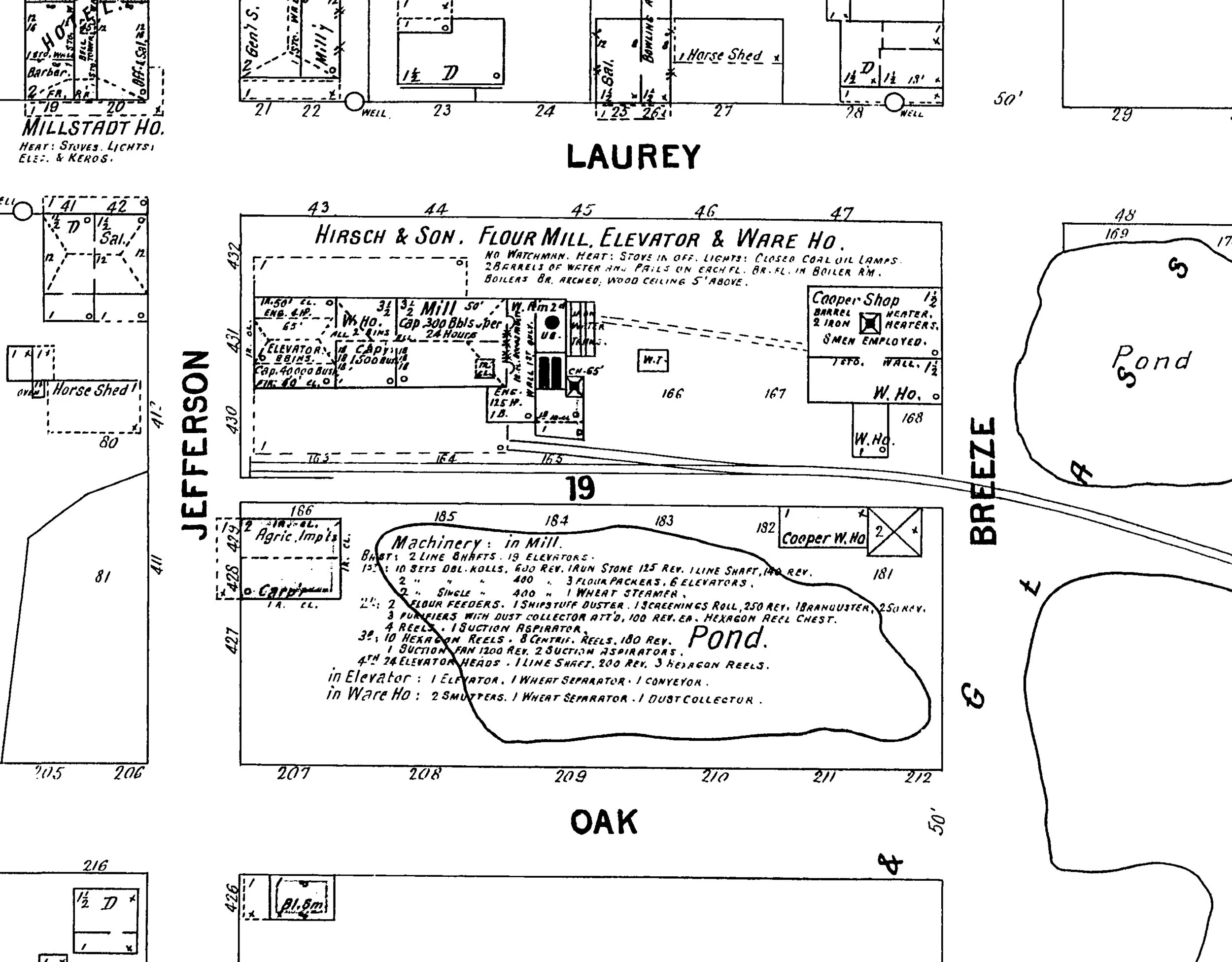
1900 Sanborn fire insurance map: listing the mill's machinery: millstone, roller stands, separators, and reels.
The mill sits on lots 163 through 168 in Glass and Stookey's Addition to Millstadt. Delinquent tax rolls in the Belleville Semi-Weekly Advocate name some owners of those lots back into the 1850s. J. Ashlock held part of the parcel in 1853 and Thomas Linn in 1854. From 1860 through 1866 the lots were taxed to F. Bauer and Company, the surname alternately printed as Beuer, Braun, Baur, and Bauer in different years. Franz Bauer is credited as the builder of this mill by Helfrich, and he also was responsible for the construction of another mill two blocks away. That mill became the Millstadt Brewery in 1902, and was demolished in the 1960s.
The 1863 plat of the town, under its old name of Centerville, shows a rectangular structure standing on these lots. Bauer owned this land as early as 1860, and a building stood on it by 1863. By 1873 Christopher Stern had bought up the block, and two of the lots were valued far above the surrounding residential parcels, strongly indicating some type of commercial usage.
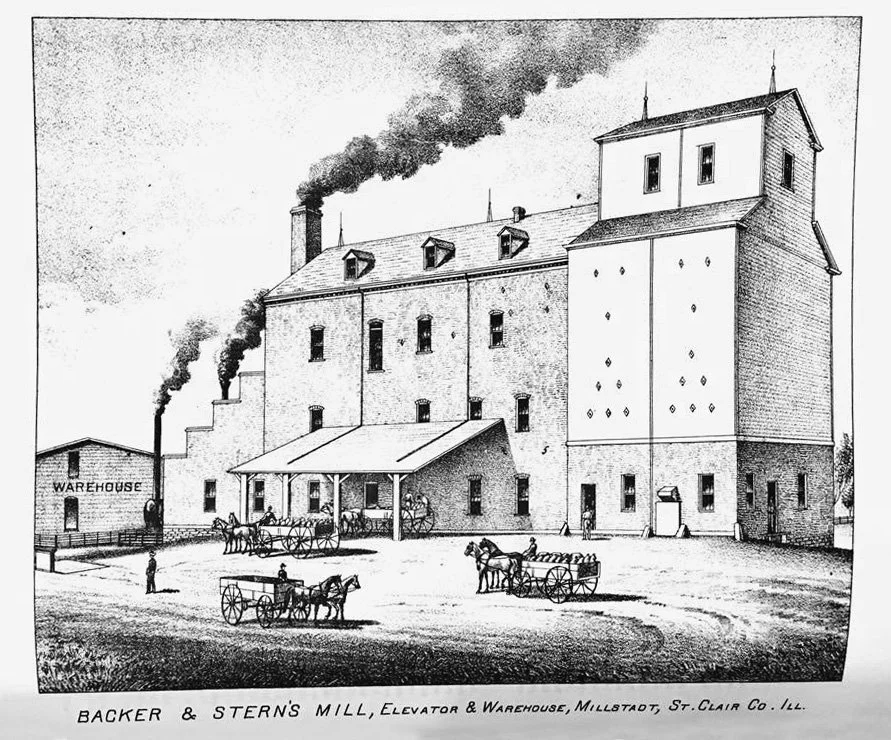
Backer [sic] and Stern's Mill, Elevator and Warehouse, from the 1881 History of St. Clair County.
In 1880, the firm of Baker and Stern built a new wheat elevator alongside their mill. The Advocate reported this as a sign of a flourishing business. The 1881 History of St. Clair County illustrates the completed plant as Baker and Stern's Mill, Elevator and Warehouse. The brick mill with the elevator tower attached at right, looks remarkably similar to the building that stands today. The name is printed BACKER there. Spelling is again inconsistent, other sources print it as Becker.
The ownership runs unbroken from that point. Baker and Stern became insolvent in 1885. John Hirsch and Edward Schoening bought the mill that year and ran it until 1900, when they sold it to the Millstadt Milling Company. It passed later to Midland Milling and to Handy Feed and Grain, and to the Helfrich family in 2017.
One thing the record does not settle: whether the brick structure standing now is the same one shown on the corner in 1863, or if it is a newer mill built on the same site. The building's exact construction date is not well-documented. What is documented is continuous occupation of the corner by millers from 1860 forward, a rectangular structure on the lots by 1863, and the current mill-and-elevator configuration complete by 1881.
Though built up in stages, the mill appears as a consistent whole. The mill block keeps its nineteenth-century form under the whitewash, with arched window heads and decorative brickwork visible from the rear. On the north side end is a small section of lighter construction, clad in board and metal, with a pass-through bay for truck loading. It does not appear on the 1928 Sanborn map, but does appear in a 1940 aerial photographic survey of St. Clair County. The 1881 illustration also shows a stepped rear section, what appears to have been a pump house, that is missing from the current footprint.
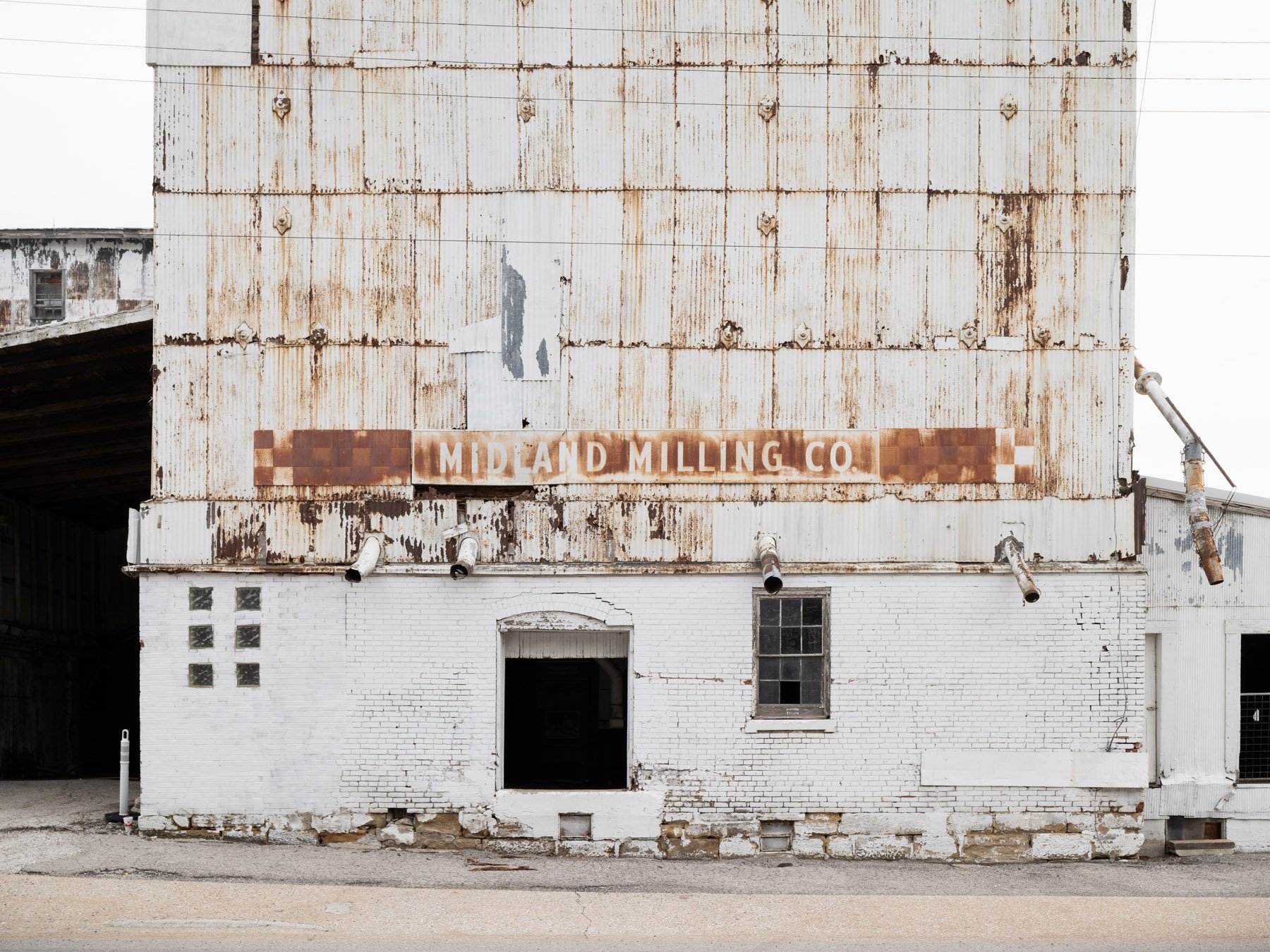
The MIDLAND MILLING CO sign on the west facade, one of several names the building has carried.
Inside, the structure is heavy timber and built-up plank columns with cross-bracing, and cast-iron columns carrying the upper floors. On the elevator section there is external evidence of the cross bracing, with star bolts especially evident on the front. The grain elevators inside this section are cribbed wooden structures, the walls built up from stacked planks. This is typical construction for a mill of its era, and it is largely intact.
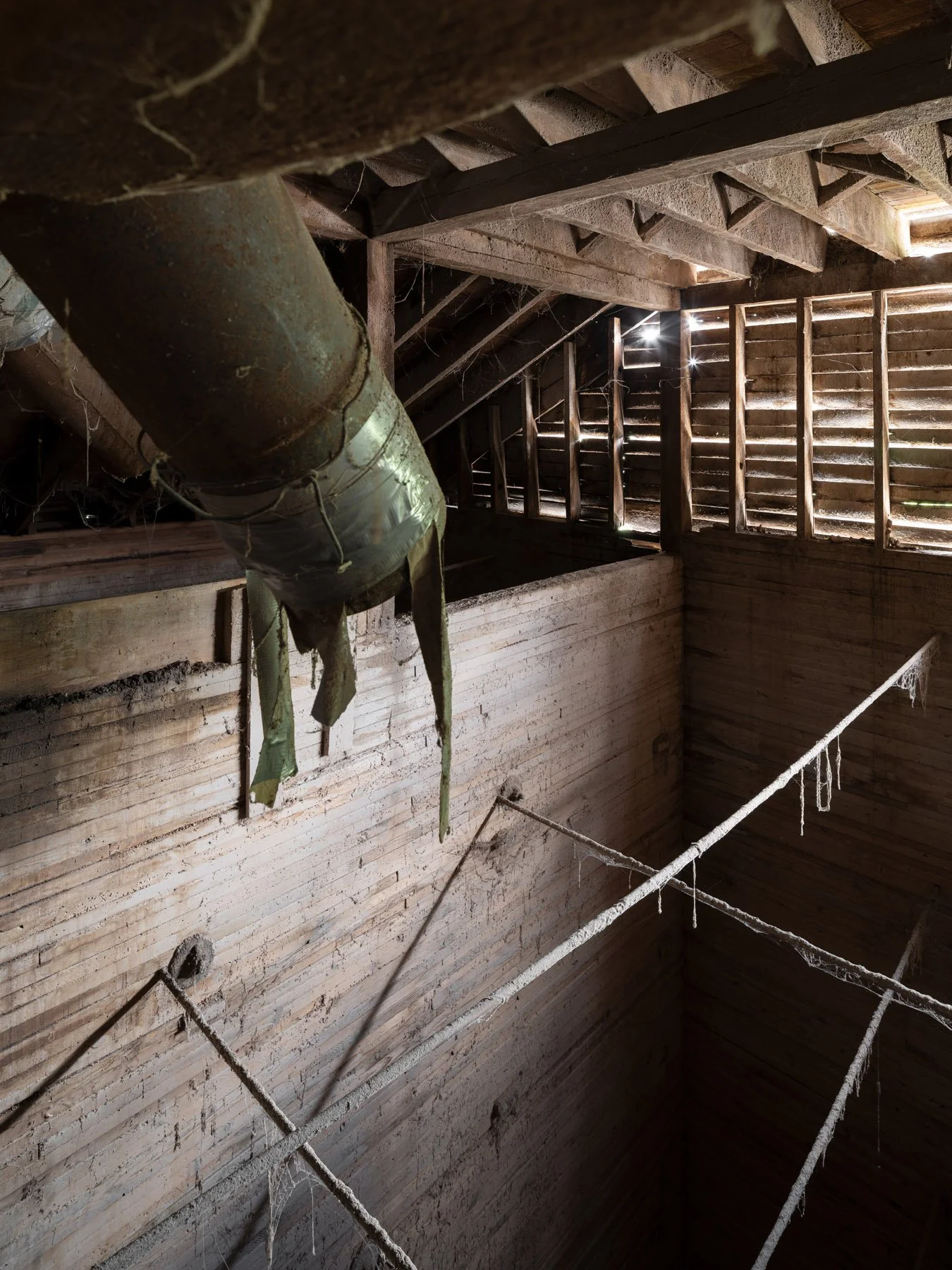
At the top of the elevator - interior of one cribbed timber grain bin.
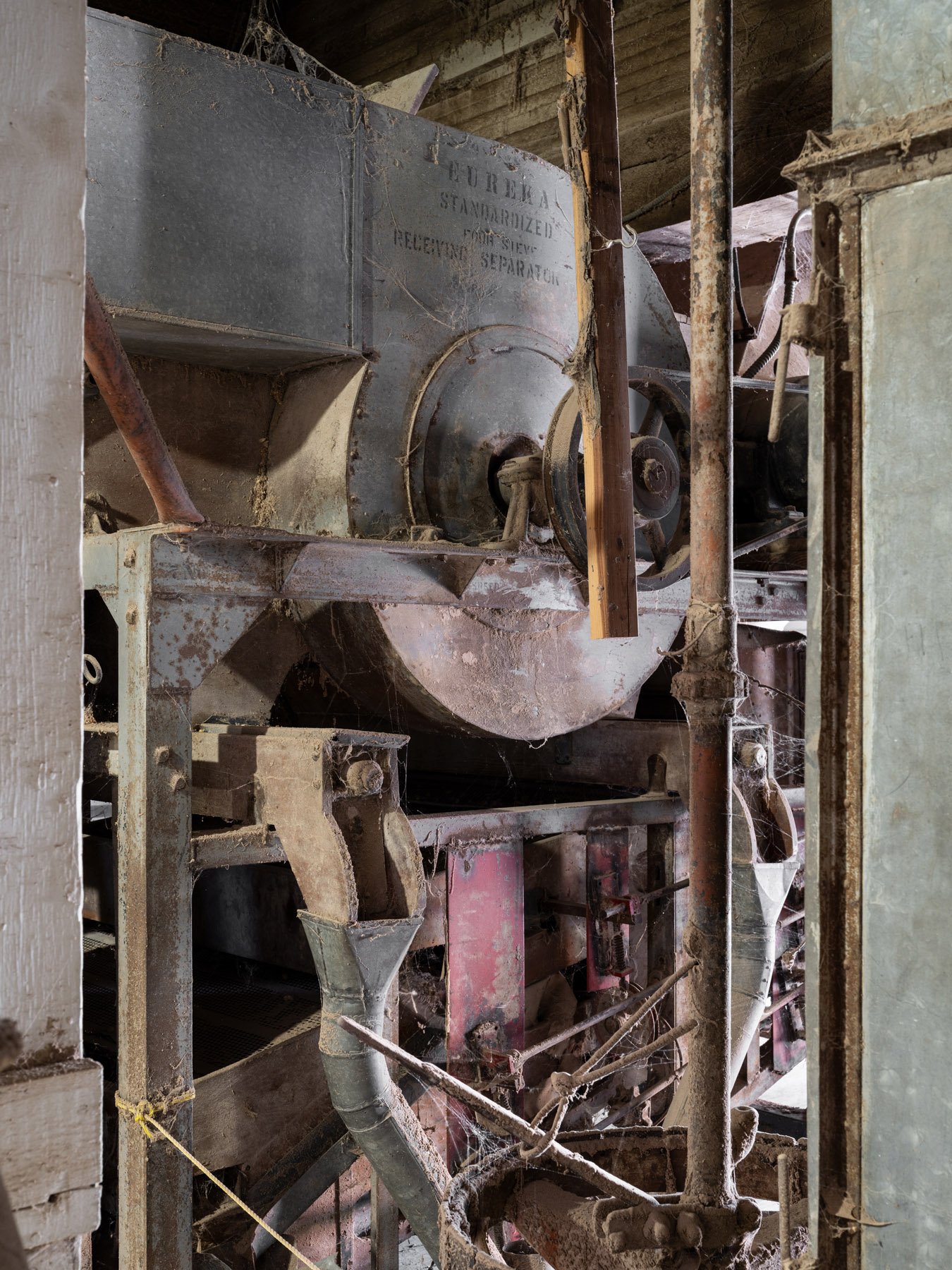
The S. Howes Eureka receiving separator, the raw grain intake point.
The machinery survives largely in place, and it can be read as one system from grain intake to finished product. Grain entered through cleaning and separating machinery. A receiving separator by the S. Howes Company of Silver Creek, New York, stenciled EUREKA, took the raw grain first. A screen separator by A. T. Ferrell and Company of Saginaw, Michigan, graded it. An aspirator stenciled NIAGARA, made by the Richmond Manufacturing Company of Lockport, New York, drew off chaff and dust, and a Howes dust collector handled the waste air. A reel marked Richmond Manufacturing, number 34, sits in the same run. Of course there is more to the process, but these are named manufacturers, clearly legible on the machines, and they place the mill's fit-out in the roller-milling era.
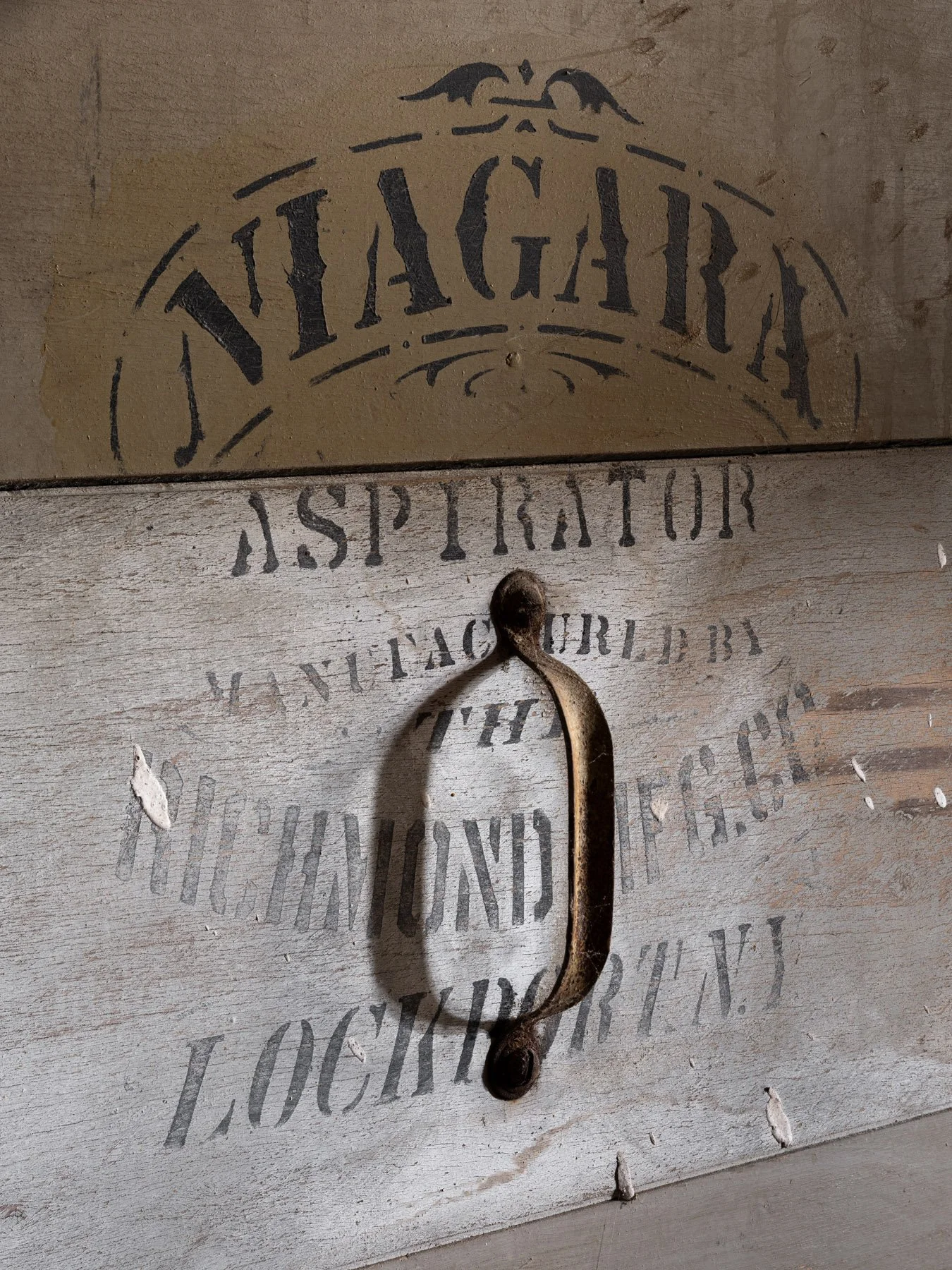
The Niagara aspirator, made by the Richmond Manufacturing Company, Lockport, New York, which drew off chaff and dust.
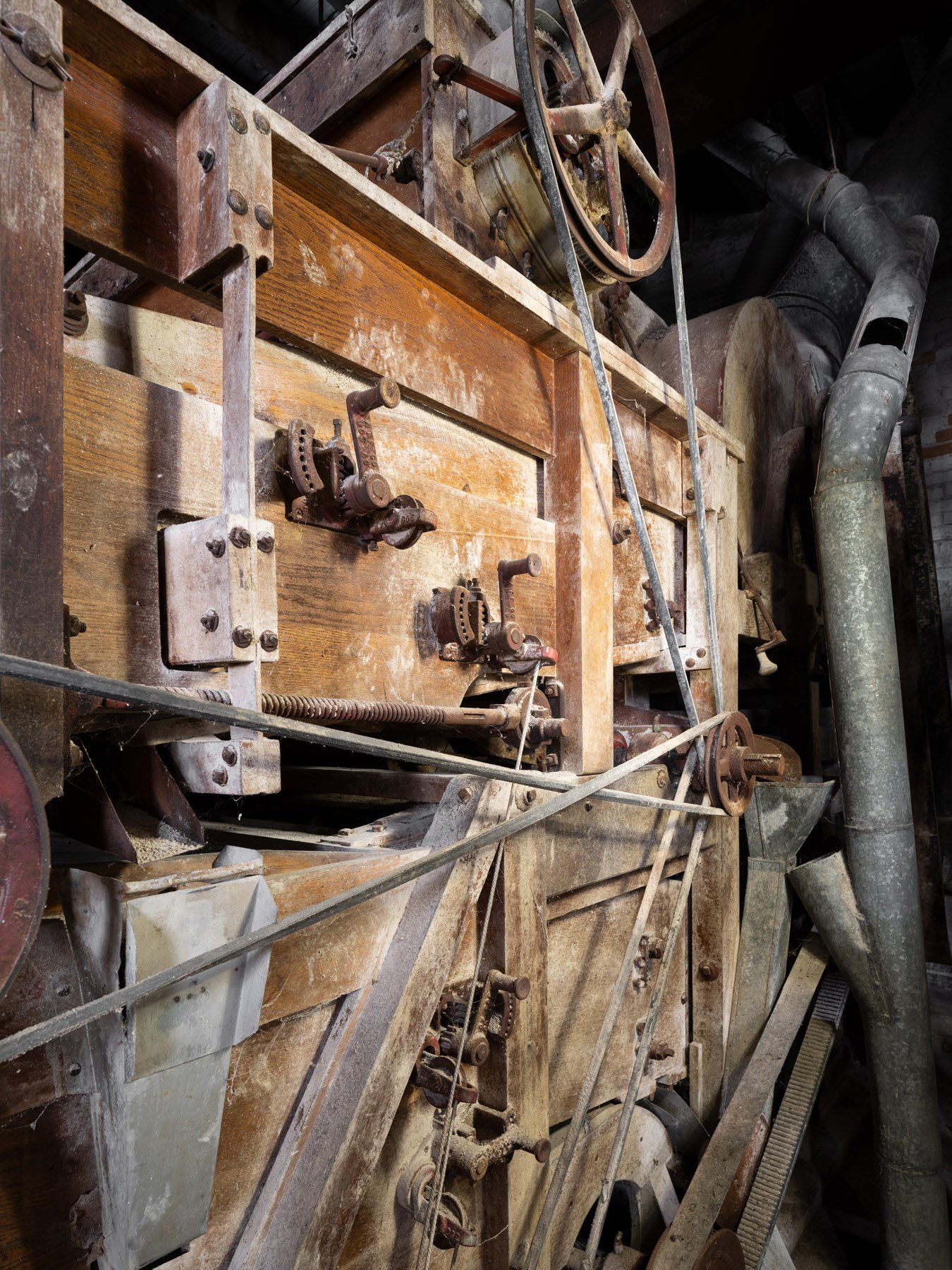
Side view of the wood-cased roller mill, belt-driven from a line shaft overhead.
From cleaning, the grain went to the rollers. A wood-cased roller mill stands in the building, belt-driven from a line shaft overhead. This is the machine that matters most for what the mill was. The 1900 Sanborn map records the plant with a single run of millstones alongside ten sets of double rolls, which is a stone mill in the middle of its conversion to a roller mill. The roller stand in the building is the physical side of that record.
Crushed grain went back up to the sifters. Two gravity sifters are in the same room as the roller mill, tall wood-cased boxes, their sieve frames numbered by hand from two through seventeen. Between the machines run the spouting, and the line-shaft transmission with its pulleys, belts, and gearing, the power system that drove the whole plant off a single source. A visitor can go and trace the grain's path through the system.
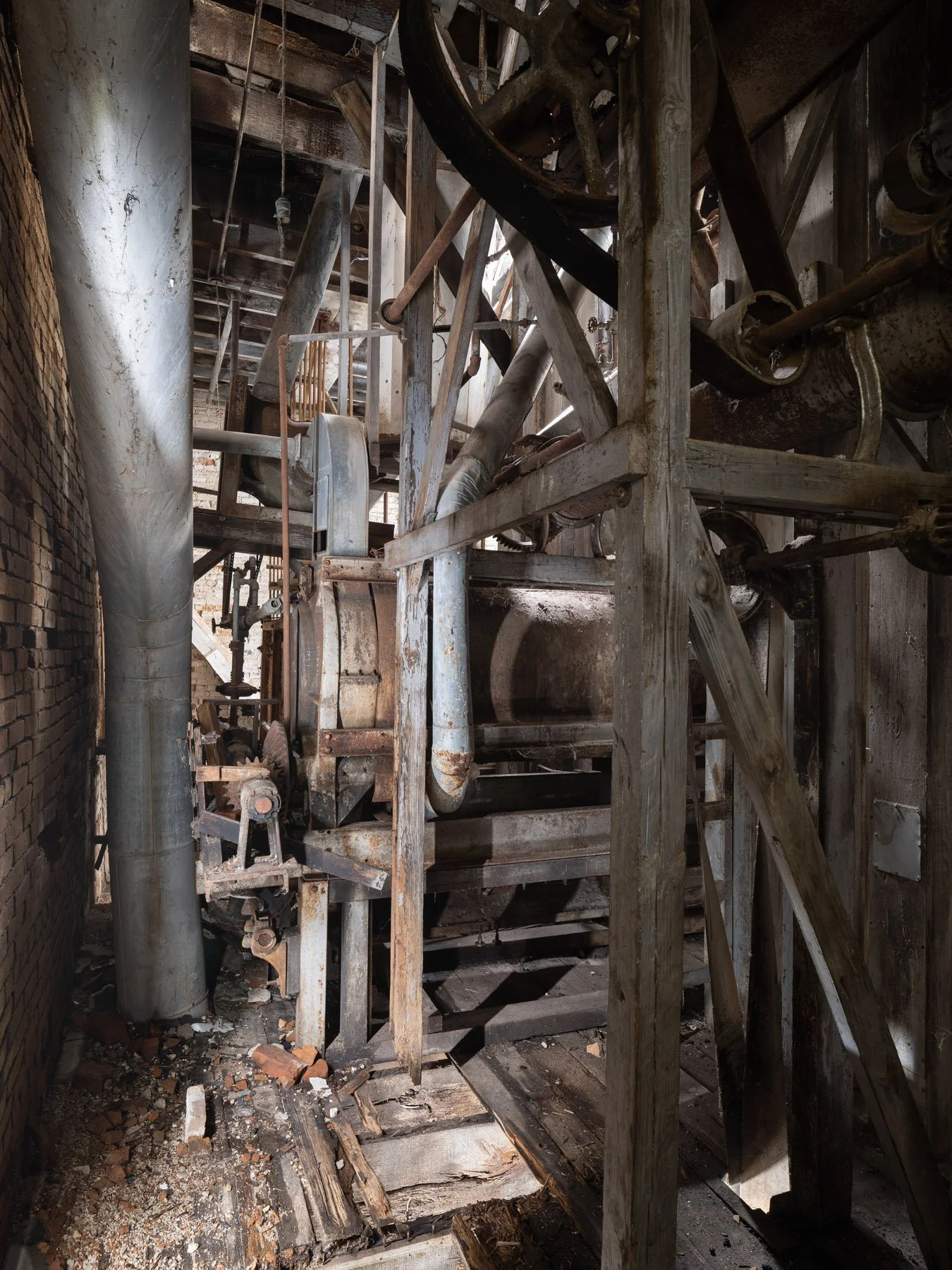
Behind machinery, showing line-shaft transmission.
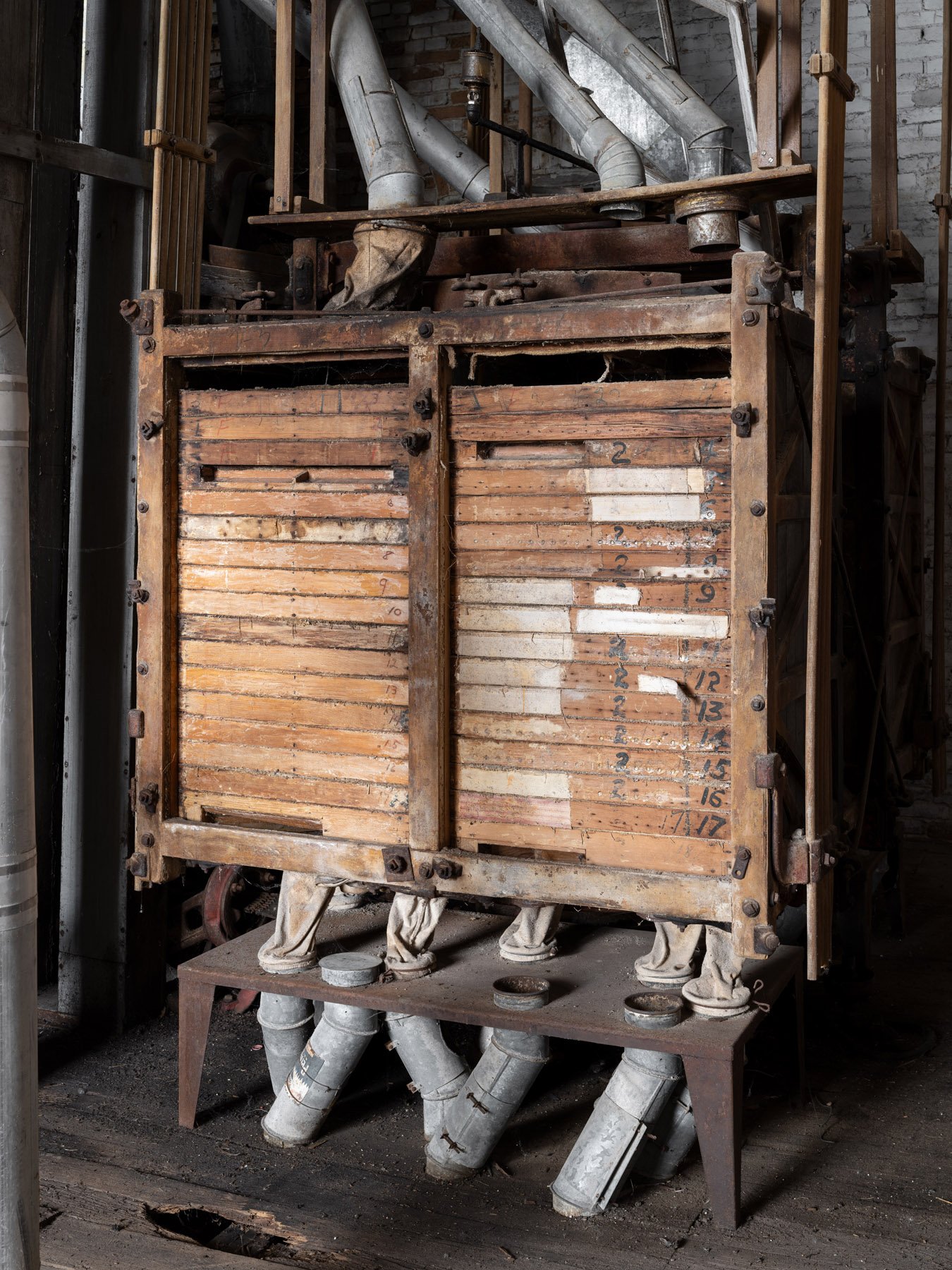
A gravity sifter with hand-numbered sieve frames.
The Sanborn fire insurance maps track the plant's function across three decades. In 1900 it was a steam-powered flour mill, with the stone-and-roller configuration noted above. By 1910 it was a feed mill running on a small electric-assisted engine. By 1928 it was fully electric, its first story rebuilt in brick, its elevator capacity reduced to 25,000 bushels. The building holds an historical arc of milling economics within itself: stone flour milling, then roller flour milling, then feed milling.
Listing a structure on the National Register does not require that it be the oldest or the first of its kind. It requires integrity, meaning the building still reads as what it was, and has a documented association with a significant historical pattern. The exact founding date, and whether it was 1857 or later, does not have much bearing on its worthiness to be included in the National Register, or to be culturally valuable in general.
The association is clear enough. The mill embodies the conversion of American flour milling from millstones to steel rollers in the 1880s, and the shift from independent flour milling to feed milling and further consolidation that followed. A great swath of the history of this industry is physically legible here, particularly in the machines.
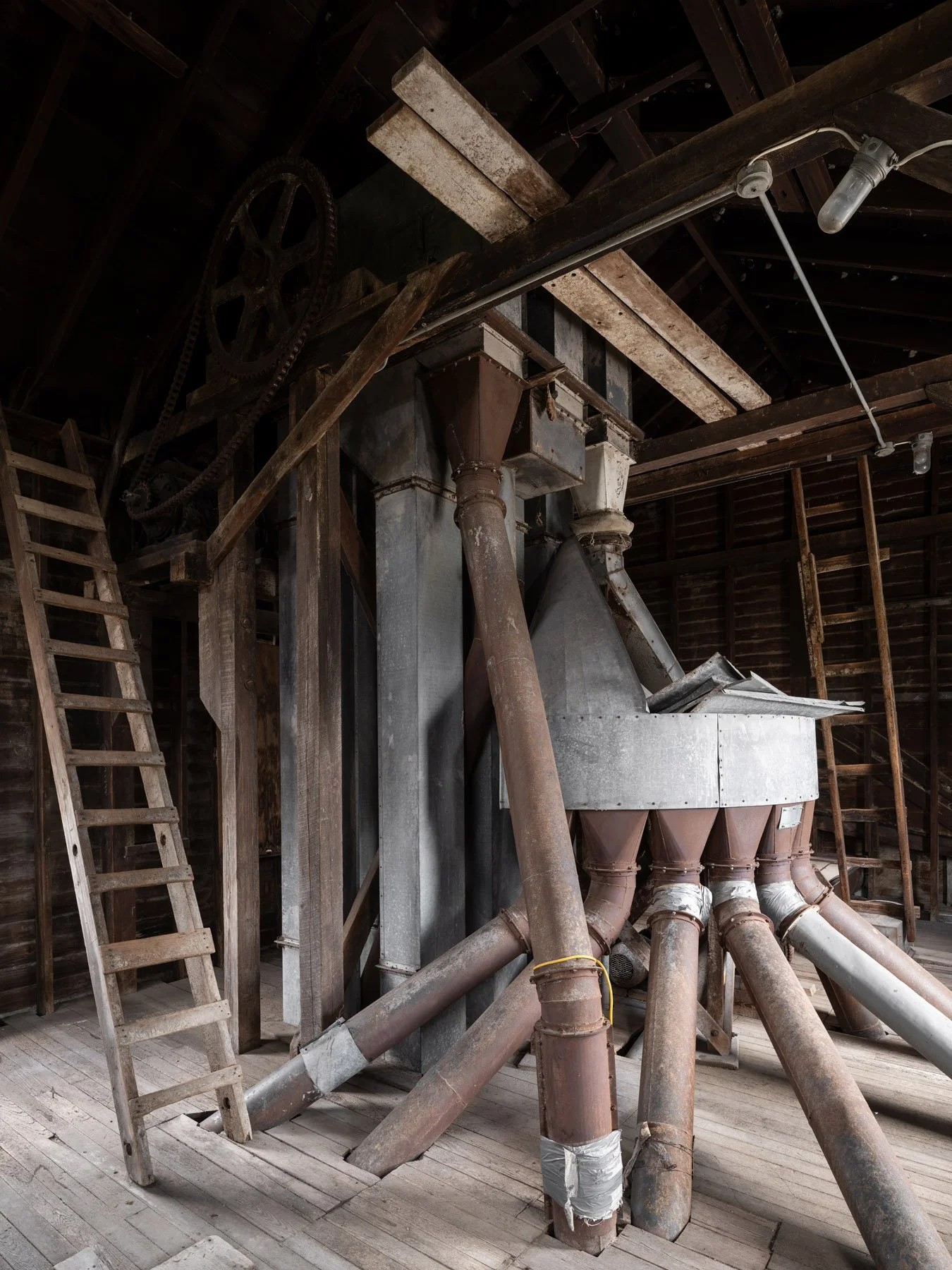
The distributor in the penthouse, routing stock from one point out to machines across the floor.
The integrity is also clear, and unusually so. The building retains its form, its structure, and a milling system that can be read end to end, with named machinery from identifiable makers. Most mills of this generation were stripped a long time ago. This one is still functional. It was purchased with the intention of turning it into an operational museum. That would be the best possible outcome.
The owners claim that Illinois Department of Natural Resources found the building eligible for the National Register. The state's HARGIS database contains no entry for the property, and no nomination exists that I can find. That doesn’t mean it’s not in the system, but it’s not readily findable. The eligibility, whatever its basis, hasn’t been carried far enough. The case seems not to have been made to the state.
The building stands on ground that has been a mill site since at least the 1860s, with a documented chain of ownership and a surviving milling system, under community pressure and a demolition deadline that has already passed. The record is as clear as the machinery is intact. This is not a marginal case, or a close call. It is a significant building that has been treated as a public nuisance.
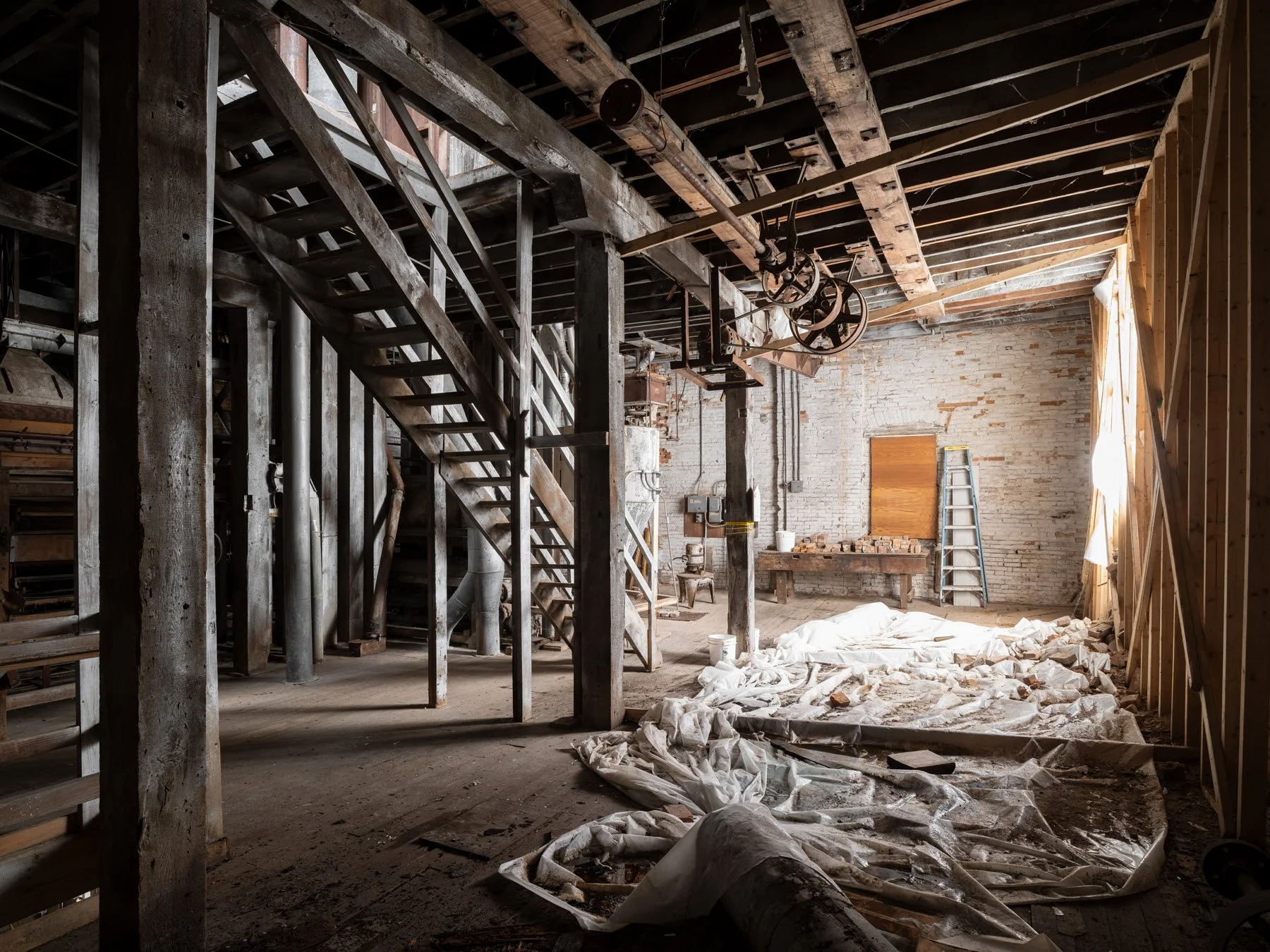
An interior room, with a line-shaft pulley overhead and wall damage at right.
See Also
The current owners maintain a website here: https://millstadtmill.com and they also have a petition to stop the demolition order on the mill.
Photographer Richard Sprengeler has been documenting grain elevators and mills in the region, including this one.
Works Cited
The Semi-Weekly Advocate (Belleville, Illinois). Delinquent tax lists, 1853, 1854, 1860, 1861, 1862, 1866, and 1873.
The Semi-Weekly Advocate (Belleville, Illinois). Report of Baker and Stern's elevator construction, 1880.
The Semi-Weekly Advocate (Belleville, Illinois). Baker and Stern insolvency notice, 1885.
The Semi-Weekly Advocate (Belleville, Illinois). Hirsch and Schoening purchase, 1885.
History of St. Clair County, Illinois. Brink, McDonough & Co., 1881.
Sanborn Fire Insurance Map, Millstadt, Illinois, 1900.
Sanborn Fire Insurance Map, Millstadt, Illinois, 1910.
Sanborn Fire Insurance Map, Millstadt, Illinois, 1928.
Plat map of Centerville (Millstadt), Illinois, 1863. Millstadt Historical Society.
Historical aerial photography of St. Clair County, Illinois, 1940. Illinois Historical Aerial Photography (ILHAP) program, Illinois State Geological Survey. https://clearinghouse.isgs.illinois.edu/webdocs/ilhap/county/j_stclair.html
Landmarks Illinois. "2019 Most Endangered Historic Places: Millstadt Milling & Feed Company," 2019.
Illinois State Historic Preservation Office. HARGIS database (Historic and Architectural Resources Geographic Information System).
Robert Buecher. "The Early History of Millstadt, Illinois." Rev. 2013. Millstadt Historical Society.
Millstadt Mill. Owners' website and on-site banners. Accessed 2026. https://millstadtmill.com/