
Linda’s Mavica
My friend Linda gave me a Sony Digital Mavica that had been owned by her father. It's a square grey chunk of a camera that was introduced in 1997, and looks it. It produces tiny 640 by 480 pixel JPEGs. They are written to a 3.5-inch floppy disk, which inserts into a slot on the side of the camera. It came in an old Case Logic sling bag with a battery, the manual, and four yellow floppies, hand-labeled SONY, 11, 12, and 13. Before I used any, I checked to see if there was anything on them. I found thirty-nine pictures that Linda's father had taken, presumably not long after he bought it. He tried it out around the house, then made a few portraits of his family. That seemed to be it.
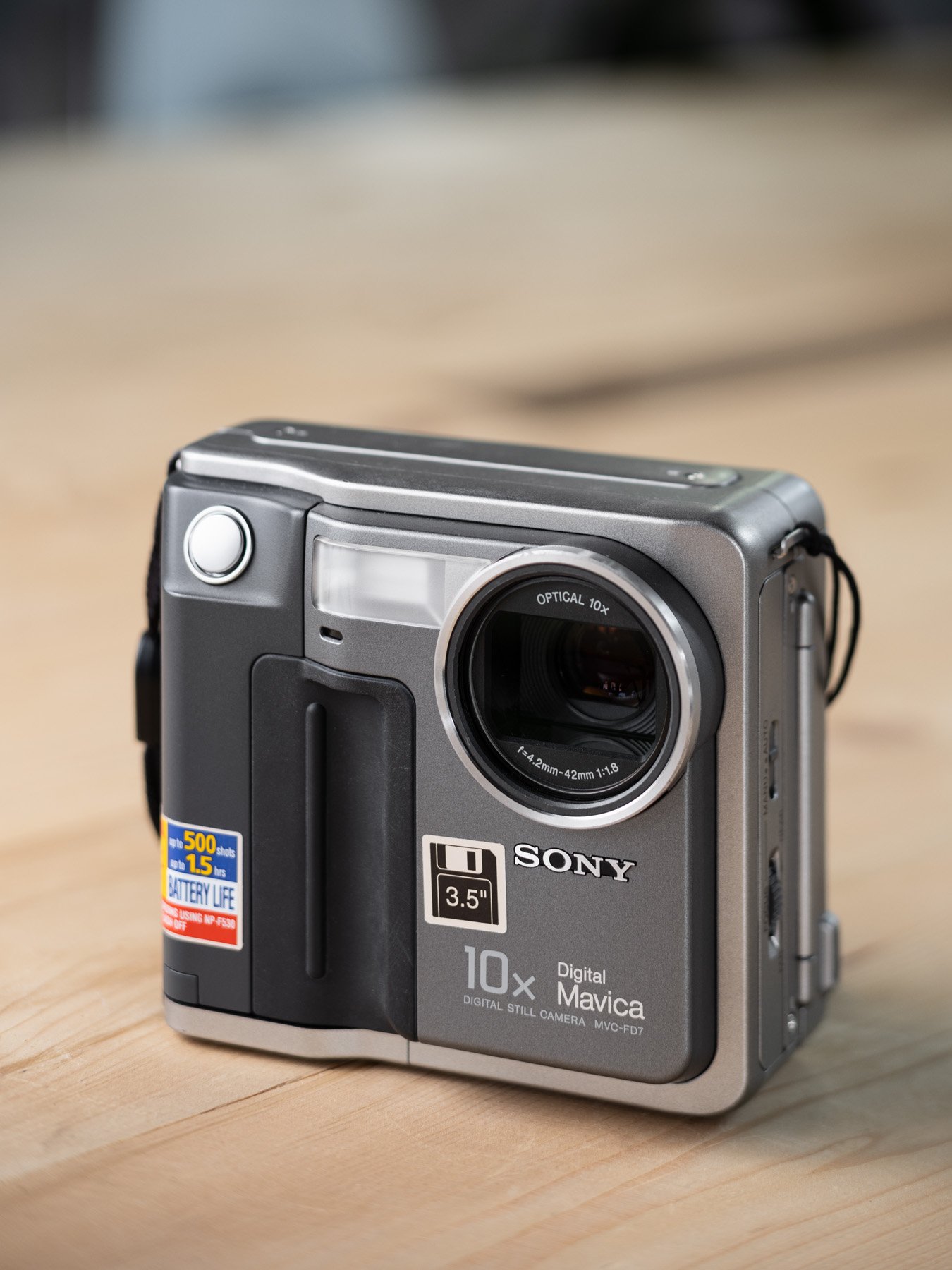
Sony Digital Mavica MVC-FD7
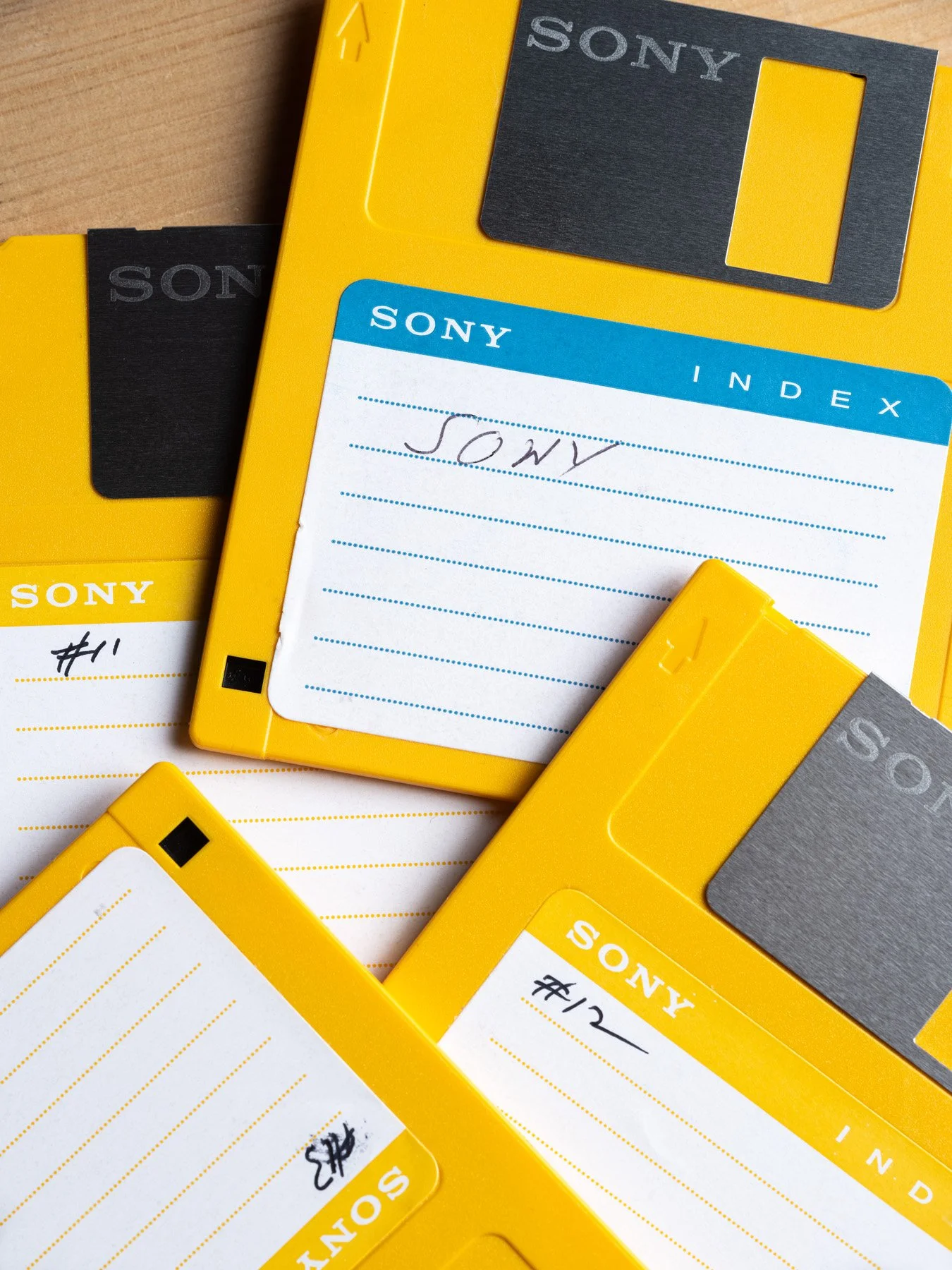
The hand-labeled floppies that came with it
I searched the camera's model number online, MVC-FD7, and found a few contemporaneous websites reviewing the camera. One of them is Lucas Pereira's page hosted by the Stanford graphics lab, posted in 1998. A camera review on a PhD student's personal page, complete with a tilde, sitting twenty-eight years on a university server. He says he wasn't careful about testing conditions, that the images posted on the page are just snapshots from a stroll around the building. They're indistinguishable from what the camera makes now. Strip the subject and you can't tell 1998 from 2026.
This was an early born-digital camera, an attempt to solve a problem of its moment, how to make a photograph and get it onto a computer quickly, bypassing film. That problem was solved so completely, by this camera and all that came after it, that the solution became ordinary. But the Mavica is new enough that its support system still exists. A USB floppy reader costs 20 bucks on Amazon. JPEG was and still is the dominant image format of the web. Deadstock floppies and third-party NP-F35 battery chargers are easy to find. The camera works fine in 2026. It hasn't been viable as a product since the early 2000s, but remains a usable device. Charge the battery and it makes pictures that can be uploaded straight to the web, just as intended.
The Mavica line was a great success. It sold over a million units by the end of 1999 and was part of the sweeping transition from film to digital photography among the general public. But its success depended on conditions that didn't last.
Floppy disks were used in this design because they were cheap and ubiquitous at the time. CompactFlash cards existed but were expensive. And resolution this low was exceeded within a year. So the Mavica is an artifact of a future that was briefly the present.
This was a product aimed squarely at consumers. At the time, professional architectural photographers were still shooting 4x5 sheet film and ripping Polaroids. Photojournalists were two years from a semi-affordable DSLR, the D1. It was for people who wanted to get images on the internet right now, or who didn't want to pay for film but could afford a $900 camera. The spread in what a photograph could look like was enormous, from digital home snaps to slick high-gloss chromes.
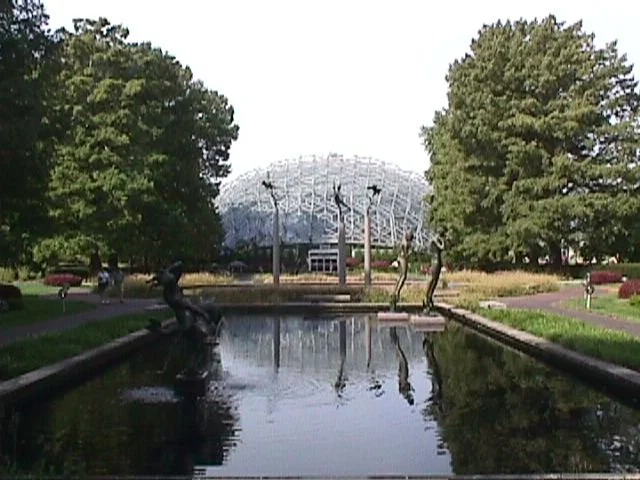
Climatron, Missouri Botanical Garden. Sony Mavica MVC-FD7.
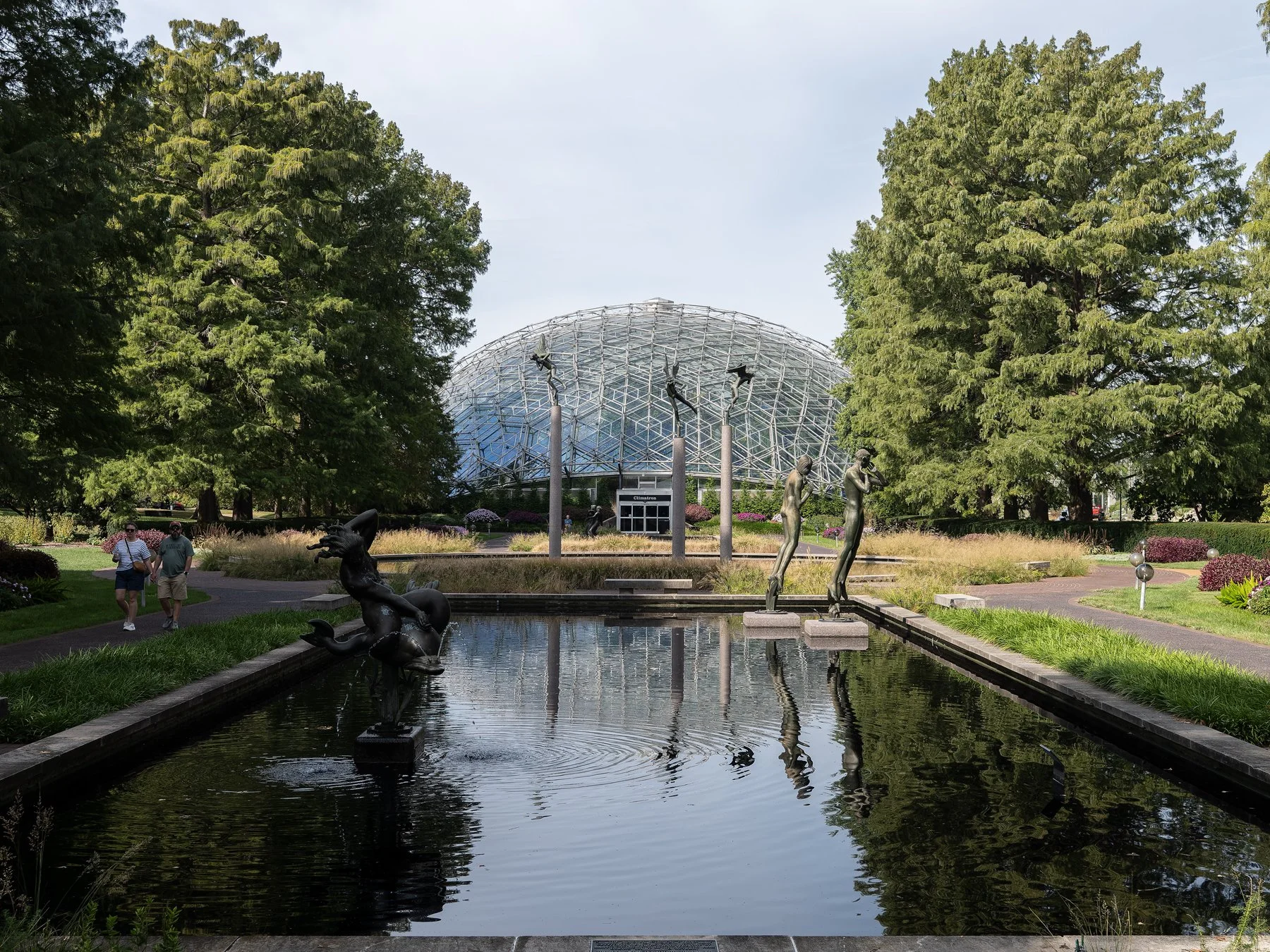
Climatron, Missouri Botanical Garden. Nikon Z7, 28mm, cropped to match.
High-end modern cameras are good at being invisible in the image. They can make a photograph that doesn't immediately reveal the camera or the era that made it. The technology has become transparent, or at least it isn't legible in the moment. The Mavica isn't transparent. You can see the machine. Qualities like color rendition or compression are inscribed in every frame.
Pereira writes in detail how the Mavica is essentially a repurposed camcorder. It writes single compressed frames to floppy instead of video to tape. The images come off the sensor interlaced, the way video does. In field mode the camera uses only half the interlaced frame, so a 640×480 file is upsampled from 640×240. In frame mode it combines both fields, which provides better resolution. But the two fields are two exposures, slightly offset in time. Anything that moves between them tears. He demonstrates this with a friend waving his arms, and with his own hand shake. His conclusion is to shoot single field while handholding.
When I'm off the clock, I tend to prefer simple camera setups, probably like most people. I try to remove camera decisions and concentrate on seeing. The Mavica makes that easy because it doesn't give you much to work with. The LCD is tiny. There's a twiddly focus dial that works, but I can't judge focus on the screen, so I just leave it on autofocus. There's no manual exposure, only EV compensation. I left it at zero. Field, not frame, high compression. Pereira's recommendations.
I took it to the Missouri Botanical Garden, my usual proving ground for testing gear. It's walking distance from my office and an easy place to shoot without pressure. I made pairs of exposures with the Mavica and my Nikon Z7 and a 28mm Z lens, then cropped the Z7 frames to match. The Mavica's lens is a 40mm equivalent at its widest, with an optical zoom I didn't use. After every exposure, the LCD says "recording," a red light indicating disk use blinks, and a little disk wheel animation spins. Ten seconds, watching the wheel spin.
It's odd to watch the world in front of you melt into 1997. It's a similar feeling to using a Polaroid Land Camera. You're standing there wondering what this will look like as a Polaroid. The camera forces the present through the visual apparatus of the past. An imperfect time machine. You have to squint hard through it to imagine what the thing really did look like. It means consciously filling in information that's simply missing from the frame, a mental form of upsampling.

Herring House, Missouri Botanical Garden. Sony Mavica MVC-FD7.
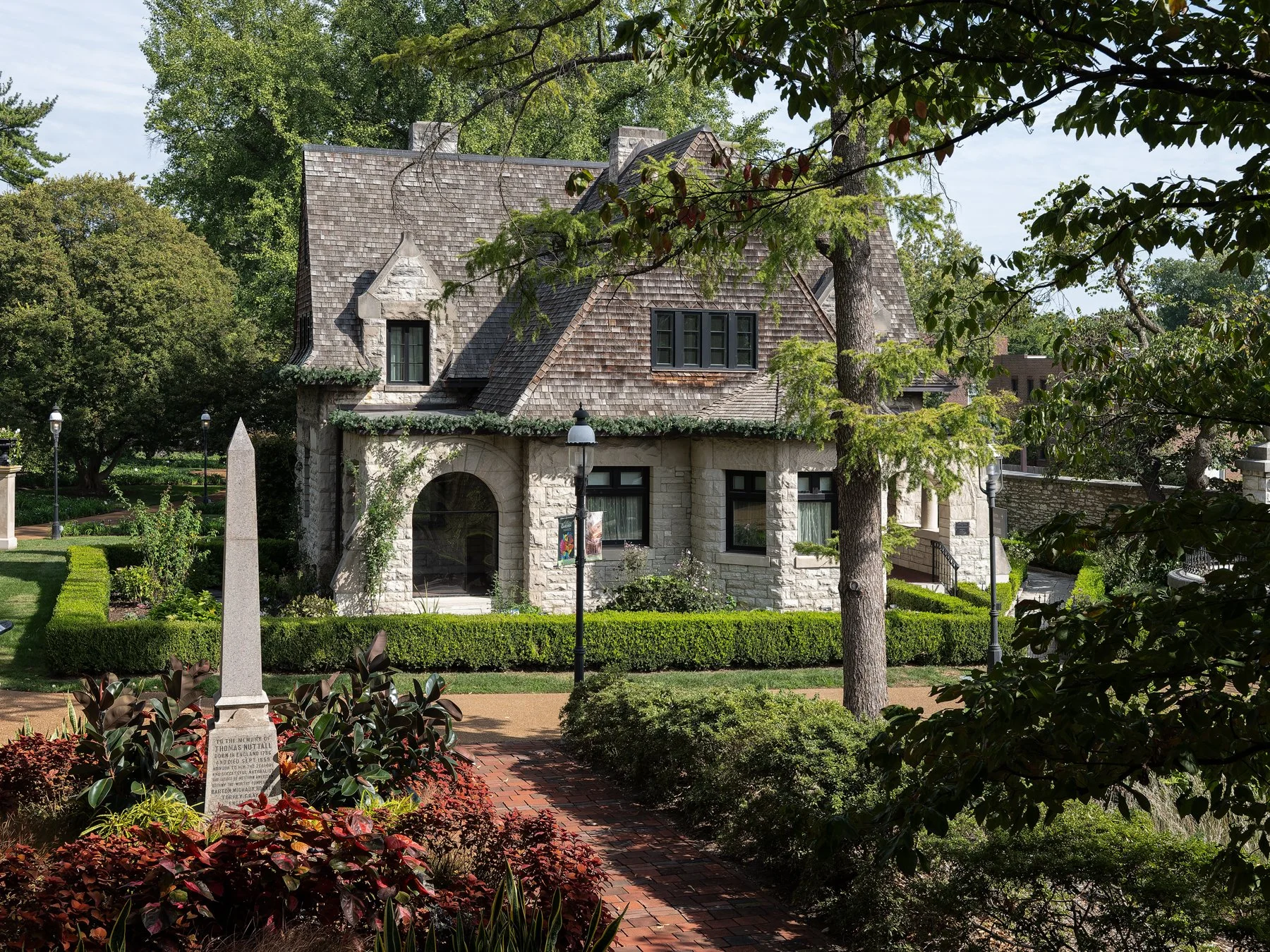
Herring House, Missouri Botanical Garden. Nikon Z7, 28mm, cropped to match.
Linda's father tested the camera out around the house. There are pictures of furniture with and without flash, in window light and tungsten. He tried out the 10x optical zoom with close-ups of cabinet knobs. He took it outside too, to a road construction project, all palm trees and pylons. And then a few portraits of his family: his wife, his son, his two grandchildren.
I thought I could see his afternoon from the files. He was going through the camera's options one at a time, the kind of pictures you make while reading the manual. The Mavica's signature is written across the portraits, the same color and compression that it gave Pereira.
When I asked Linda, she recognized him testing every feature, but she could read things I couldn't. The furniture is at her brother's house. Her parents must have been visiting, maybe on a last trip from Atlanta before they moved across the country. Maybe he bought the camera in Chattanooga. Her mother in a flowered shirt, the reflection in the mirror, and the cactus were all at their new house in Las Vegas. He'd packed the camera for the move and pulled it back out at the new house to try it again.
The camera encodes the look of 1997 into every frame, but the houses and the move between them are in Linda's memory. Linda had the context to see them. She says her father always had the newest and best of things, like this camera.
Some photographs aren't easy to date by their medium. Why does a well-made black-and-white 4x5 negative from last week look like one from a hundred years ago, while a Mavica photograph always looks like 1997? 4x5 has a huge amount of latitude in how the practitioner can use it. It's nearly a blank sheet. A specialist might date a negative by the film stock or printing method, but nothing in particular about the medium announces itself. The subject is the best indicator of when it was made, and only if you have the context to read it.
You can date a 2011 iPhone photo within a few years. But it doesn't announce its date the way a Mavica file does. Its signature is faint, and you only notice it in retrospect. Mavica files look the way they do because the camera is a camcorder writing interlaced fields. An autochrome looks the way it does because its grain is dyed potato starch. Early DSLRs had a muddy look because of poor color response in those sensors. All three are the aesthetic residue of engineering solutions. Now they're date stamps, which is why they can be counterfeited. Film grain and tape warble are sold as filters now, skeuomorphic approximations for the sake of vibes.

Victorian Garden and Sachs Museum, Missouri Botanical Garden. Sony Mavica MVC-FD7.
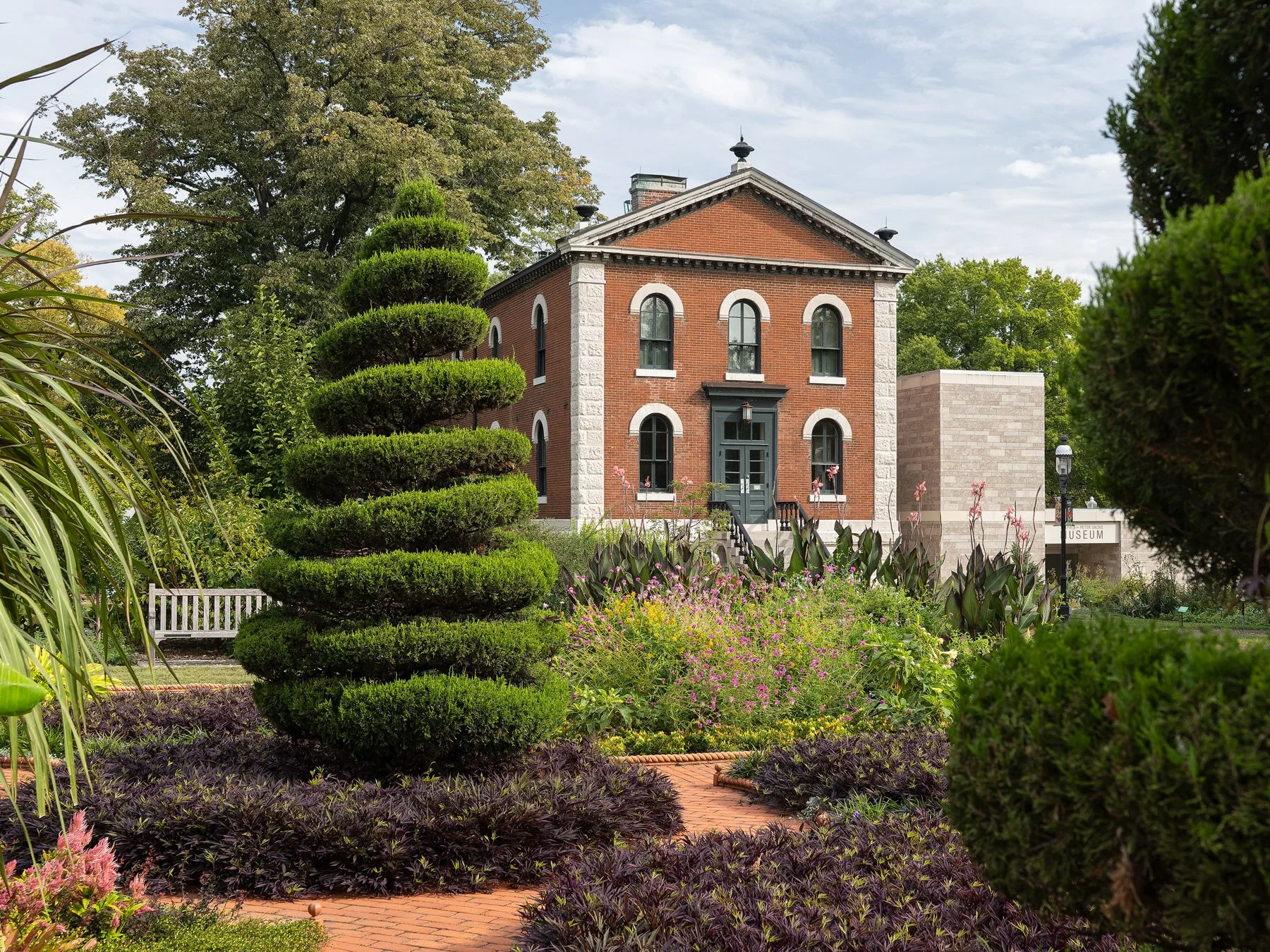
Victorian Garden and Sachs Museum, Missouri Botanical Garden. Nikon Z7, 28mm, cropped to match.
High-end modern cameras may only be invisible in the image from inside 2026. Their big files might well read as unmistakably 2026 in twenty years for reasons none of us can see now. Nobody in 1997 thought a Mavica file looked like 1997. It just looked like a picture made for the internet.
You can't format a floppy disk in the Mavica, nor can you flip through and delete files. You have to physically insert the disk into a computer, right-click the drive, and format it. Floppy disks themselves aren't manufactured anymore. You'd have to buy them as deadstock, so the disks that came with the camera were the ones I had.
Linda later told me her father kept a whole cabinet of floppy disks, which are gone now. Software used to ship on a dozen or more floppies, so the 11, 12, and 13 on these labels might be what's left of an installer, reused for pictures and never relabeled. We'll never know. I copied off everything that was on them, then formatted Linda's father's disks. I packaged up all the files for her, and sent a Google Drive link of photos he had made of her mother, brother, niece and nephew, testing out his brand-new Sony Digital Mavica.